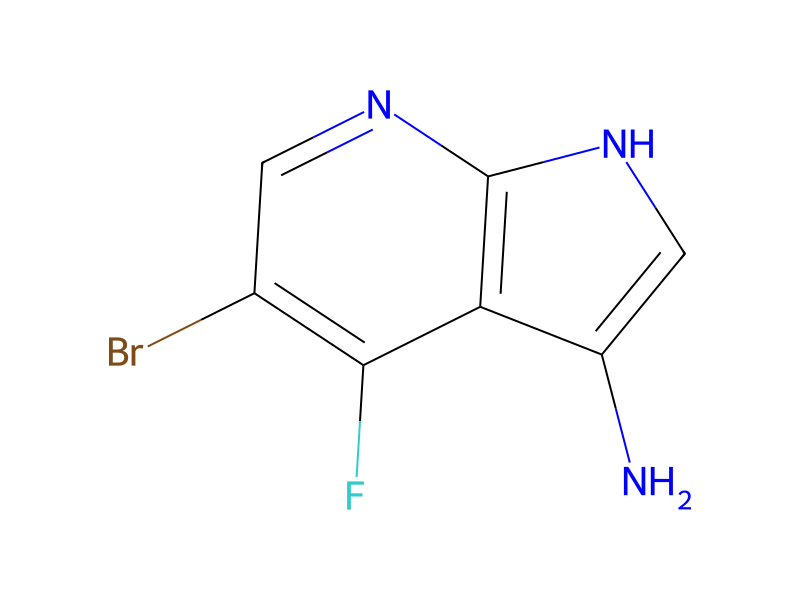
Sodium Hydroxide → 5-bromo-4-fluoro-1H-pyrrolo[2,3-b]pyridin-3-amine
Reaction equation

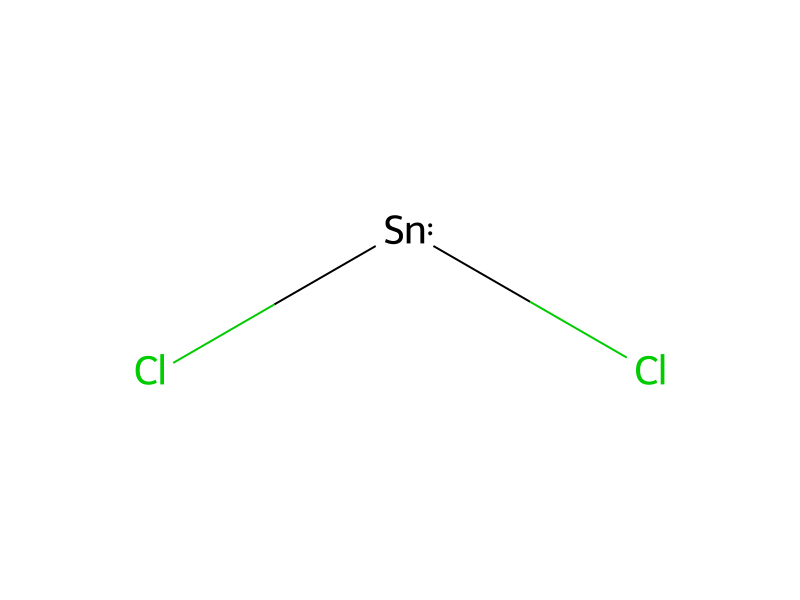
[Sn](Cl)Cl.[Br:4][C:5]1[C:6]([F:17])=[C:7]2[C:13]([N+:14]([O-])=O)=[CH:12][NH:11][C:8]2=[N:9][CH:10]=1.[OH-].[Na+]>Cl>[Br:4][C:5]1[C:6]([F:17])=[C:7]2[C:13]([NH2:14])=[CH:12][NH:11][C:8]2=[N:9][CH:10]=1Participants
5



Procedure
Tin (II) chloride (10 g, 54 mmol) was slowly added to 5-bromo-4-fluoro-3-nitro-1H-pyrrolo[2,3-b]pyridine (9.0 g, 35 mmol) in 6N HCl (200 mL) at a temperature of about 0° C. to about 5° C., and the reaction was stirred at room temperature for 2 hours. The reaction pH was raised to 7 by addition of 6N NaOH. The aqueous layer was then extracted with CHCl3/i-PrOH (3:1). The combined organic phases were dried (MgSO4) and concentrated in vacuo to yield 5-bromo-4-fluoro-1H-pyrrolo[2,3-b]pyridin-3-amine (5.1 g, 64% yield) as a solid. 1H NMR (400 MHz, (CD3)2SO) δ 11.18 (br s, 1H), 8.13 (d, 1H), 6.66 (d, 1H), 4.21 (s, 2H); LCMS (APCI+) m/z 229.9, 231.9 (M+H)+, Retention time=2.11 minutes (Method 1).
Workup
- extractionThe aqueous layer was then extracted with CHCl3/i-PrOH (3:1)
- dry with materialThe combined organic phases were dried (MgSO4)
- concentrationconcentrated in vacuo
Sources & evidence
- ORD record
- ord-6dd672e1240a4d2c9957de1f670729f3
- Source dataset
- uspto-grants-2015_03
- Patent number
- US08981085B2
Reaction notes
Loading…