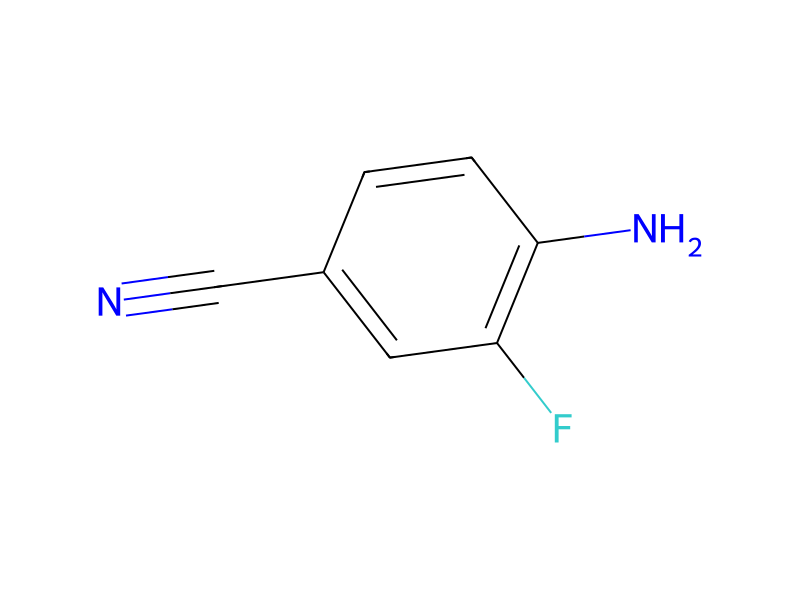
4-Amino-3-fluorobenzonitrile → HCID 67222178, compound
Reaction equation

[C:1]([C:5]1[CH:10]=[CH:9][C:8]([N:11]2[CH2:16][CH2:15][O:14][C@H:13]([C@@H:17]([OH:21])[C:18]([OH:20])=O)[C:12]2=[O:22])=[CH:7][CH:6]=1)([CH3:4])([CH3:3])[CH3:2].[NH2:23][C:24]1[CH:31]=[CH:30][C:27]([C:28]#[N:29])=[CH:26][C:25]=1[F:32].NC1C=C2C(=CC=1)C(N(C(OC(C)(C)C)=O)C(OC(C)(C)C)=O)=NC=C2>>[C:1]([C:5]1[CH:6]=[CH:7][C:8]([N:11]2[CH2:16][CH2:15][O:14][C@H:13]([C@@H:17]([OH:21])[C:18]([NH:23][C:24]3[CH:31]=[CH:30][C:27]([C:28]#[N:29])=[CH:26][C:25]=3[F:32])=[O:20])[C:12]2=[O:22])=[CH:9][CH:10]=1)([CH3:4])([CH3:3])[CH3:2]Participants
4


Procedure
According to the Step 1-3 in synthetic method for EXAMPLE 1, a cyclic carbonate analogue (0.2 g) derived from compound 52-4 and 4-amino-3-fluorobenzonitrile (81.7 mg) were used instead of 1-2 and 6-amino-1-bis(tert-butoxy carbonyl)aminoisoquinoline, under high concentration condition (1M), to obtain compound 67-1 (130 mg) as a colorless amorphous solid.
Sources & evidence
- ORD record
- ord-4bd52831e94d454aa96ca186c46a2575
- Source dataset
- uspto-grants-2015_03
- Patent number
- US08987242B2
Reaction notes
Loading…