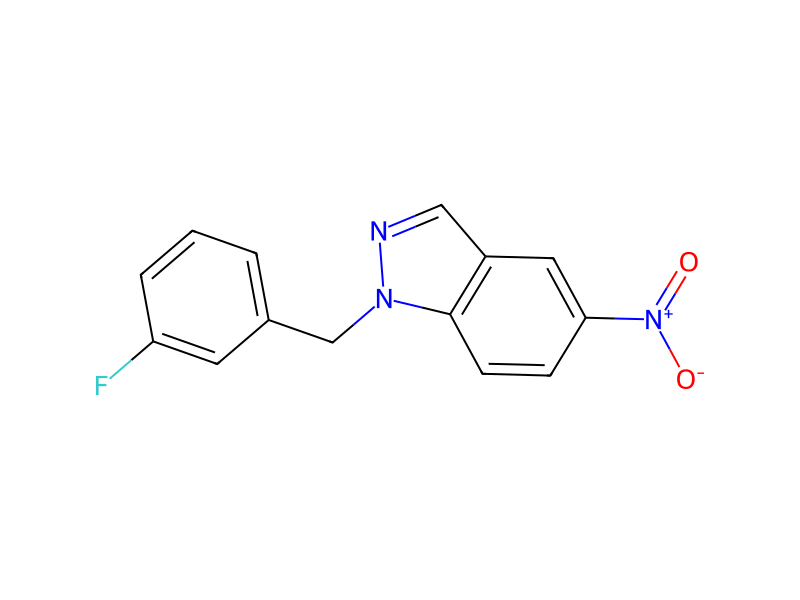
Potassium Carbonate → 1-(3-fluorobenzyl)-5-nitro-1H-indazole
Reaction equation

[N+:1]([C:4]1[CH:5]=[C:6]2[C:10](=[C:11]3C=CC=C[C:12]=13)[NH:9][N:8]=[CH:7]2)([O-:3])=[O:2].[F:17][C:18]1[CH:19]=[C:20]([CH:23]=[CH:24][CH:25]=1)[CH2:21]Br.C(=O)([O-])[O-].[K+].[K+]>CC(C)=O.ClCCl>[F:17][C:18]1[CH:19]=[C:20]([CH:23]=[CH:24][CH:25]=1)[CH2:21][N:9]1[C:10]2[C:6](=[CH:5][C:4]([N+:1]([O-:3])=[O:2])=[CH:12][CH:11]=2)[CH:7]=[N:8]1Participants
6
Reactant 3

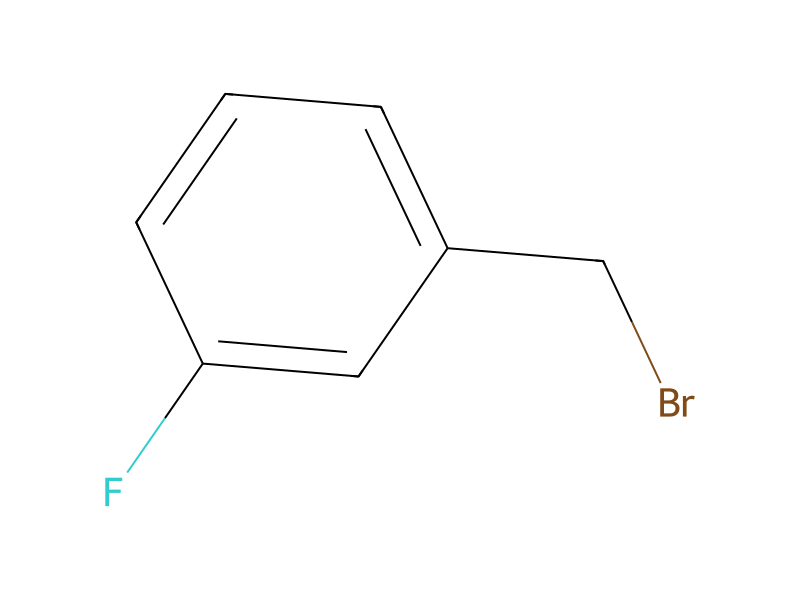

Product 1
Reagents, catalysts & solvents 2


Procedure
A suspension of 5-nitrobenzoindazole (8.16 g, 50 mmol), 3-fluorobenzyl bromide (10.4 g, 55 mmol) and potassium carbonate (13.8 g, 100 mmol) in acetone (200 mL) was refluxed overnight. After reaction cooled to room temperature, the reaction mixture was diluted with dichloromethane (100 mL), filtered through silica gel (about 100 g), and rinsed with 1:1 ethyl acetate:dichloromethane (about 100 mL). The residue after concentration was purified with column chromatography eluting with 0-30% ethyl acetate in dichloromethane to give the title compound as a white crystalline solid (the first fraction, 5.69 g, 42%). LCMS ESI(+) m/z: 272 (M+1).
Workup
- temperaturewas refluxed overnight
- customAfter reaction
- filtrationfiltered through silica gel (about 100 g)
- washrinsed with 1:1 ethyl acetate
- concentrationThe residue after concentration
- customwas purified with column chromatography
- washeluting with 0-30% ethyl acetate in dichloromethane
Sources & evidence
- ORD record
- ord-c6ca13f4567949cb8bcae927ec11db3b
- Source dataset
- uspto-grants-2015_03
- Patent number
- US08987284B2
Reaction notes
Loading…