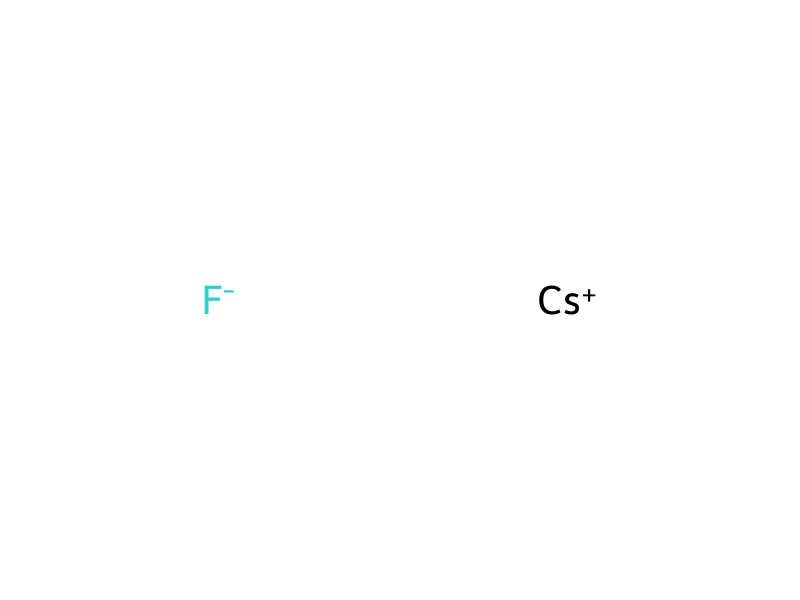
Cesium fluoride → HCID 68289659, compound
Reaction equation

Br[C:2]1[CH:11]=[CH:10][C:5]([C:6]([O:8][CH3:9])=[O:7])=[C:4]([F:12])[CH:3]=1.[CH2:13]([Sn](CCCC)(CCCC)CCCC)[CH:14]=[CH2:15].[F-].[Cs+]>O1CCOCC1.C1C=CC([P]([Pd]([P](C2C=CC=CC=2)(C2C=CC=CC=2)C2C=CC=CC=2)([P](C2C=CC=CC=2)(C2C=CC=CC=2)C2C=CC=CC=2)[P](C2C=CC=CC=2)(C2C=CC=CC=2)C2C=CC=CC=2)(C2C=CC=CC=2)C2C=CC=CC=2)=CC=1>[CH2:15]([C:2]1[CH:11]=[CH:10][C:5]([C:6]([O:8][CH3:9])=[O:7])=[C:4]([F:12])[CH:3]=1)[CH:14]=[CH2:13]Participants
6




Procedure
Methyl 4-bromo-2-fluorobenzoate (424 mg, 1.82 mmol), allyl tributyl tin (0.846 mL, 2.73 mmol), tetrakis(triphenylphosphine)palladium (0) (105 mg, 0.091 mmol) and cesium fluoride (415 mg, 2.73 mmol) were heated to reflux in 1,4-dioxane (10 mL) for 7 hours under argon atmosphere. The mixture was cooled to room temperature, and then filtered through diatomaceous earth by ethyl acetate and the filtrate was concentrated under reduced pressure. The residue was purified by silica gel column chromatography (ethyl acetate/hexane=2%→10%) to give methyl 4-allyl-2-fluorobenzoate (333 mg, 94%) as a pale yellow viscous material.
Workup
- filtrationfiltered through diatomaceous earth by ethyl acetate
- concentrationthe filtrate was concentrated under reduced pressure
- customThe residue was purified by silica gel column chromatography (ethyl acetate/hexane=2%→10%)
Sources & evidence
- ORD record
- ord-1fe75cae6f2d4a7797eafe28285fddd2
- Source dataset
- uspto-grants-2015_03
- Patent number
- US08987445B2
Reaction notes
Loading…