Hydrochloric Acid → HCID 131732649, compound
Reaction equation

[C:1]([N:4]1[C:13]2[C:8](=[CH:9][C:10]([C:14]3[CH:27]=[CH:26][C:17]([C:18]([NH:20][CH2:21][CH2:22][N:23]([CH3:25])[CH3:24])=[O:19])=[CH:16][CH:15]=3)=[CH:11][CH:12]=2)[C@H:7]([NH2:28])[CH2:6][C@@H:5]1[CH3:29])(=[O:3])[CH3:2].Br[C:31]1[N:36]=[CH:35][CH:34]=[CH:33][N:32]=1.CC(C)([O-])C.[Na+].CN(C)C1C=CC=CC=1C1C=CC=CC=1P(C1CCCCC1)C1CCCCC1.[ClH:71]>O1CCOCC1.C1C=CC(/C=C/C(/C=C/C2C=CC=CC=2)=O)=CC=1.C1C=CC(/C=C/C(/C=C/C2C=CC=CC=2)=O)=CC=1.C1C=CC(/C=C/C(/C=C/C2C=CC=CC=2)=O)=CC=1.[Pd].[Pd]>[ClH:71].[C:1]([N:4]1[C:13]2[C:8](=[CH:9][C:10]([C:14]3[CH:27]=[CH:26][C:17]([C:18]([NH:20][CH2:21][CH2:22][N:23]([CH3:24])[CH3:25])=[O:19])=[CH:16][CH:15]=3)=[CH:11][CH:12]=2)[C@H:7]([NH:28][C:31]2[N:36]=[CH:35][CH:34]=[CH:33][N:32]=2)[CH2:6][C@@H:5]1[CH3:29])(=[O:3])[CH3:2]Participants
Reactant 5




Product 1

Reagents, catalysts & solvents 2


Conditions
- Temperature
- 100 °C
Procedure
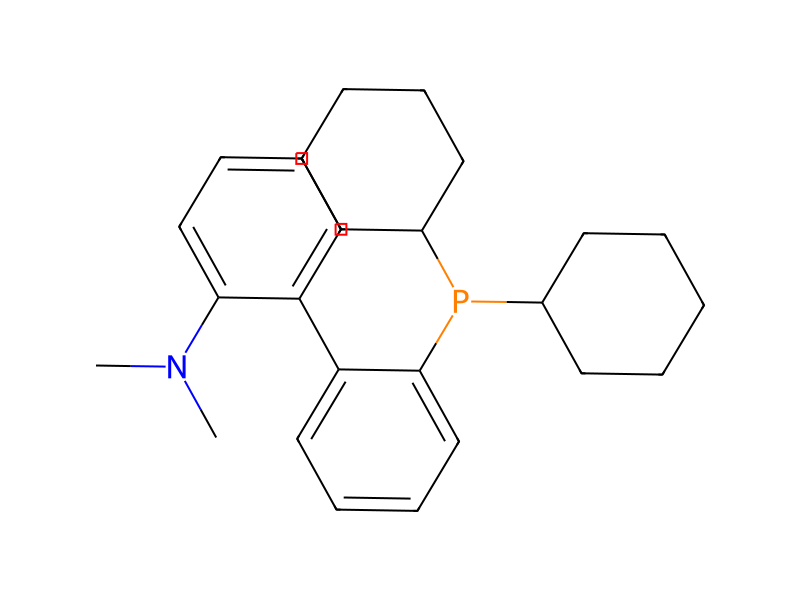
To a flask charged with 4-((2S,4R)-1-acetyl-4-amino-2-methyl-1,2,3,4-tetrahydroquinolin-6-yl)-N-(2-(dimethylamino)ethyl)benzamide (for a preparation see Intermediate 32) (197 mg, 0.5 mmol), 2-bromopyrimidine (238 mg, 1.500 mmol), sodium tert-butoxide (240 mg, 2.500 mmol), 2-(dimethylamino)-2′-(dicyclohexylphosphino)biphenyl (197 mg, 0.500 mmol) and tris(dibenzylideneacetone)dipalladium(0) (229 mg, 0.250 mmol) was added degassed toluene (4 mL) and the resulting mixture was stirred under nitrogen at 100° C. After 2 h the mixture was cooled to room temperature and most of the solvent was evaporated in vacuo. The residue was partitioned between EtOAc and saturated NaHCO3 solution and the layers were separated. The aqueous phase was extracted with EtOAc and the combined organic phases were washed with saturated aqueous NaHCO3 (×3), dried over MgSO4 and concentrated in vacuo. The residue was dissolved in DCM and loaded on a SCX column (20 g). The cartridge was eluted with DCM then ammonia in MeOH (2N). The methanolic ammonia fractions were concentrated in vacuo and further purified on by chromatography (25 g column, elution with 2N ammonia in MeOH/DCM gradient) to give a residue which was dissolved in 1,4-dioxane (4 ml) and the solution treated with hydrogen chloride in 1,4-dioxane (4N, 0.5 mL). The precipitate which formed was isolated by filtration and dried at 60° C. under vacuum for 2 h to give 4-((2S,4R)-1-acetyl-2-methyl-4-(pyrimidin-2-ylamino)-1,2,3,4-tetrahydroquinolin-6-yl)-N-(2-(dimethylamino)ethyl)benzamide, hydrochloride (93 mg, 0.183 mmol, 36.5% yield) as a pale yellow solid. LCMS (HpH, 2 min), Rt=0.79 min, MH+=473.
Workup
- additionwas added
- customdegassed toluene (4 mL)
- temperatureAfter 2 h the mixture was cooled to room temperature and most of the solvent
- customwas evaporated in vacuo
- customThe residue was partitioned between EtOAc and saturated NaHCO3 solution
- customthe layers were separated
- extractionThe aqueous phase was extracted with EtOAc
- washthe combined organic phases were washed with saturated aqueous NaHCO3 (×3)
- dry with materialdried over MgSO4
- concentrationconcentrated in vacuo
- dissolutionThe residue was dissolved in DCM
- washThe cartridge was eluted with DCM
- concentrationThe methanolic ammonia fractions were concentrated in vacuo
- customfurther purified on by chromatography (25 g column, elution with 2N ammonia in MeOH/DCM gradient)
- customto give a residue which
- customThe precipitate which formed
- customwas isolated by filtration
- customdried at 60° C. under vacuum for 2 h
Sources & evidence
- ORD record
- ord-2dd5fd05b34148b689cfccd837e54655
- Source dataset
- uspto-grants-2015_03
- Patent number
- US08993554B2
Reaction notes
Loading…