Hydrochloric Acid → HCID 131732649, compound
Reaction equation

[C:1]([N:4]1[C:13]2[C:8](=[CH:9][C:10]([C:14]3[CH:27]=[CH:26][C:17]([C:18]([NH:20][CH2:21][CH2:22][N:23]([CH3:25])[CH3:24])=[O:19])=[CH:16][CH:15]=3)=[CH:11][CH:12]=2)[C@H:7]([NH2:28])[CH2:6][C@@H:5]1[CH3:29])(=[O:3])[CH3:2].CC(C)([O-])C.[Na+].C[N:37]([CH3:63])[C:38]1C=CC=[CH:40][C:39]=1C1C=CC=CC=1P(C1CCCCC1)C1CCCCC1.[Cl:64]C1C=NC=C[N:66]=1.Cl>O1CCOCC1.C1C=CC(/C=C/C(/C=C/C2C=CC=CC=2)=O)=CC=1.C1C=CC(/C=C/C(/C=C/C2C=CC=CC=2)=O)=CC=1.C1C=CC(/C=C/C(/C=C/C2C=CC=CC=2)=O)=CC=1.[Pd].[Pd]>[ClH:64].[C:1]([N:4]1[C:13]2[C:8](=[CH:9][C:10]([C:14]3[CH:27]=[CH:26][C:17]([C:18]([NH:20][CH2:21][CH2:22][N:23]([CH3:24])[CH3:25])=[O:19])=[CH:16][CH:15]=3)=[CH:11][CH:12]=2)[C@H:7]([NH:28][C:63]2[N:66]=[CH:40][CH:39]=[CH:38][N:37]=2)[CH2:6][C@@H:5]1[CH3:29])(=[O:3])[CH3:2]Participants
Reactant 5




Product 1

Reagents, catalysts & solvents 2


Conditions
- Temperature
- 100 °C
Procedure
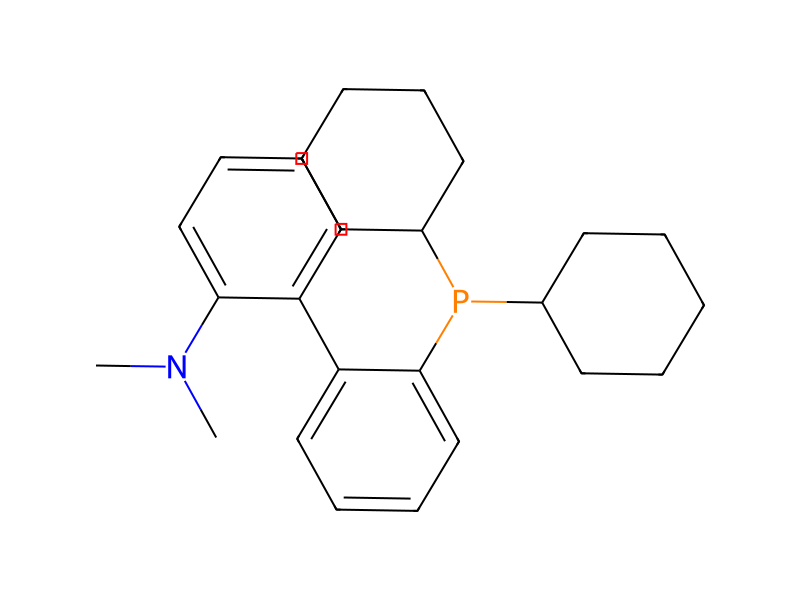
To a flask charged with 4-((2S,4R)-1-acetyl-4-amino-2-methyl-1,2,3,4-tetrahydroquinolin-6-yl)-N-(2-(dimethylamino)ethyl)benzamide (for a preparation see Intermediate 32) (197 mg, 0.5 mmol), sodium tert-butoxide (240 mg, 2.500 mmol), tris(dibenzylideneacetone)dipalladium(0) (229 mg, 0.250 mmol) and 2-(dimethylamino)-2′-(dicyclohexylphosphino)biphenyl (197 mg, 0.500 mmol) was added degassed toluene (4 mL). The resulting mixture was treated with 2-chloropyrazine (0.134 mL, 1.500 mmol) then stirred under nitrogen at 100° C. for ˜45 min. The mixture was cooled to room temperature and most of the solvent was evaporated in vacuo. The residue was partitioned between EtOAc and a saturated NaHCO3 solution and the layers were separated. The aqueous phase was extracted with EtOAc and the combined organic phases were washed with saturated aqueous NaHCO3 (×3), dried over MgSO4 and concentrated in vacuo. The residue was dissolved in DCM and loaded on a SCX column (20 g). The cartridge was eluted with DCM then with ammonia in MeOH (2N). The methanolic ammonia fractions were concentrated in vacuo and further purified by chromatography (25 g column, elution with 2N ammonia in MeOH/DCM gradient) to give a residue which was dissolved in 1,4-dioxane (4 ml). The solution was treated with hydrogen chloride in 1,4-dioxane (4N, 0.5 mL). The precipitate formed was isolated by filtration and dried at 60° C. under vacuum for 2 h to give 4-((2S,4R)-1-acetyl-2-methyl-4-(pyrimidin-2-ylamino)-1,2,3,4-tetrahydroquinolin-6-yl)-N-(2-(dimethylamino)ethyl)benzamide, Hydrochloride (93 mg, 0.183 mmol, 36.5% yield) as a white solid. LCMS (HpH, 2 min), Rt=0.79 min, MH+=473.
Workup
- additionwas added
- customdegassed toluene (4 mL)
- temperatureThe mixture was cooled to room temperature and most of the solvent
- customwas evaporated in vacuo
- customThe residue was partitioned between EtOAc
- customa saturated NaHCO3 solution and the layers were separated
- extractionThe aqueous phase was extracted with EtOAc
- washthe combined organic phases were washed with saturated aqueous NaHCO3 (×3)
- dry with materialdried over MgSO4
- concentrationconcentrated in vacuo
- dissolutionThe residue was dissolved in DCM
- washThe cartridge was eluted with DCM
- concentrationThe methanolic ammonia fractions were concentrated in vacuo
- customfurther purified by chromatography (25 g column, elution with 2N ammonia in MeOH/DCM gradient)
- customto give a residue which
- customThe precipitate formed
- customwas isolated by filtration
- customdried at 60° C. under vacuum for 2 h
Sources & evidence
- ORD record
- ord-aeff446669db45e0a98978791ab83712
- Source dataset
- uspto-grants-2015_03
- Patent number
- US08993554B2
Reaction notes
Loading…