4-Bromoaniline → N-(4-bromophenyl)-4-chloro-3-nitrobenzamide
Reaction equation

[Br:1][C:2]1[CH:8]=[CH:7][C:5]([NH2:6])=[CH:4][CH:3]=1.[Cl:9][C:10]1[CH:18]=[CH:17][C:13]([C:14](Cl)=[O:15])=[CH:12][C:11]=1[N+:19]([O-:21])=[O:20].C(N(CC)C(C)C)(C)C>C(Cl)Cl>[Br:1][C:2]1[CH:8]=[CH:7][C:5]([NH:6][C:14](=[O:15])[C:13]2[CH:17]=[CH:18][C:10]([Cl:9])=[C:11]([N+:19]([O-:21])=[O:20])[CH:12]=2)=[CH:4][CH:3]=1Participants
5
Reactant 3
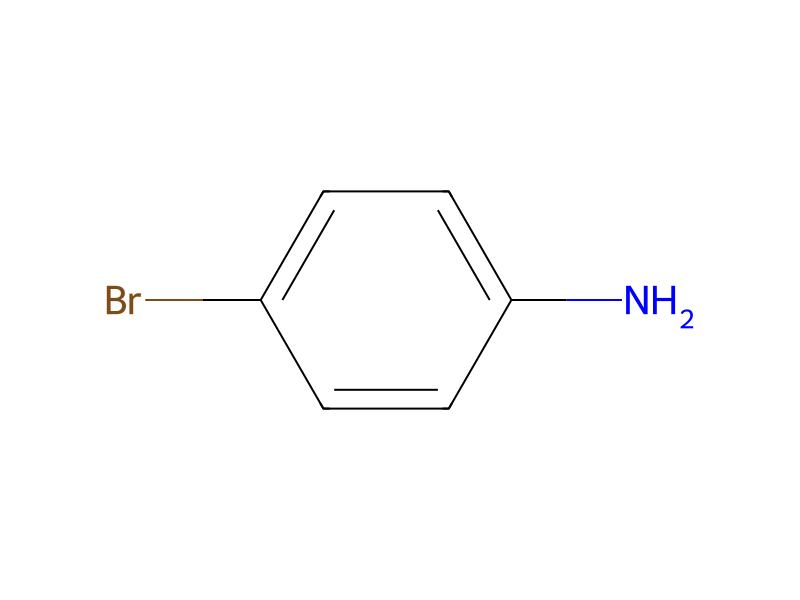


Product 1

Reagents, catalysts & solvents 1

Procedure
A mixture of 4-bromoaniline (2.58 g 14.99 mmol) in dry methylene chloride (100 mL) was treated with 4-chloro-3-nitrobenzoyl chloride (3.60 g, 17.99 mmol) and N,N-diisopropylethylamine (3.14 mL, 17.99 mmol), and the resulting mixture stirred at room temperature for 17 hours. The solvent was removed by rotary evaporation in vacuo, the residue taken up in ethyl acetate (100 mL) and washed with water (2×50 mL) and brine. Dried the organic extract over anhydrous sodium sulfate, filtered, and concentrated in vacuo to give the product as a tan solid (5.132 g, 14.45 mmol, 96%)
Workup
- customThe solvent was removed by rotary evaporation in vacuo
- washwashed with water (2×50 mL) and brine
- customDried the
- extractionorganic extract over anhydrous sodium sulfate
- filtrationfiltered
- concentrationconcentrated in vacuo
Sources & evidence
- ORD record
- ord-f40d2aaed5c04e0dafba81bd224681ad
- Source dataset
- uspto-grants-2012_08
- Patent number
- US08236950B2
Reaction notes
Loading…