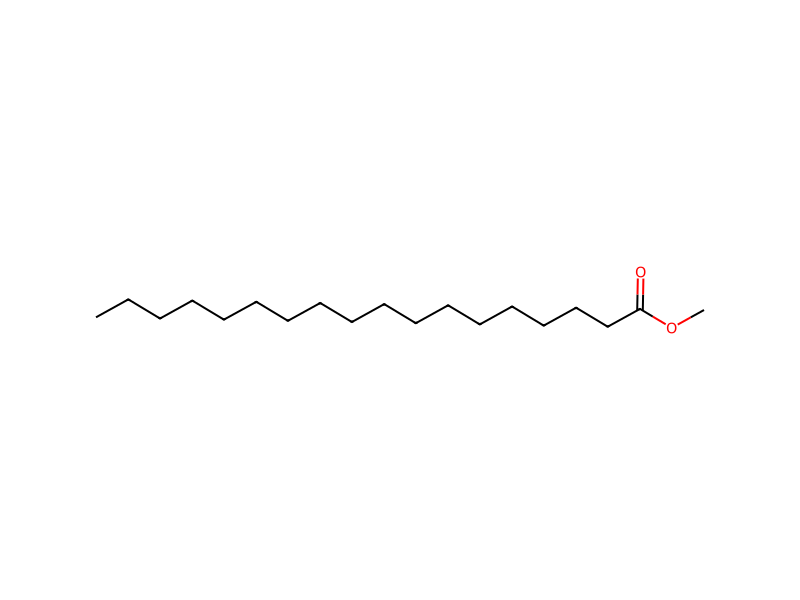
Methyl Stearate → Methyl linoleate
Reaction equation

[C:1]([O:20][CH3:21])(=[O:19])[CH2:2][CH2:3][CH2:4][CH2:5][CH2:6][CH2:7][CH2:8][CH2:9][CH2:10][CH2:11][CH2:12][CH2:13][CH2:14][CH2:15][CH2:16][CH2:17][CH3:18].C(OC)(=O)CCCCCCC/C=C\CCCCCCCC>>[C:1]([O:20][CH3:21])(=[O:19])[CH2:2][CH2:3][CH2:4][CH2:5][CH2:6][CH2:7][CH2:8]/[CH:9]=[CH:10]\[CH2:11]/[CH:12]=[CH:13]\[CH2:14][CH2:15][CH2:16][CH2:17][CH3:18]Participants
3


Procedure
Another possible route to produce different grade of palm diesel is by using partial vacuum fractionation of palm oil methyl esters. Under pressure of 25 Pa and temperature ranging between 145° C. to 154° C., mixture of methyl esters consisting 6.0% methyl palmitate, 8.5% methyl stearate, 69.5% methyl oleate and 16.0% methyl linoleate was obtained. This fraction of methyl esters exhibits pour point of below 0° C.
Workup
- customAnother possible route to produce different grade of palm diesel
- customranging between 145° C. to 154° C.
Sources & evidence
- ORD record
- ord-6337acab7c3d4670a4e090c0f7cbf808
- Source dataset
- uspto-grants-2012_08
- Patent number
- US08246699B2
Reaction notes
Loading…