Acetone → Bisphenol A
Reaction equation

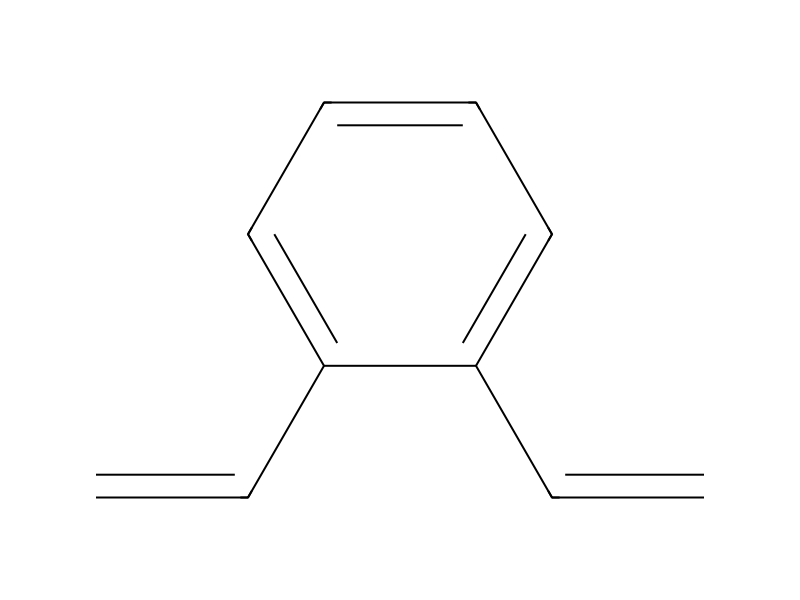
[C:1]1([OH:7])[CH:6]=[CH:5][CH:4]=[CH:3][CH:2]=1.[C:8]1(OC)[C:9](=[CH:11][CH:12]=[CH:13][CH:14]=1)[OH:10].[CH3:17][C:18]([CH3:20])=O.C(C1C=CC=CC=1C=C)=C.C(S)C>>[CH3:17][C:18]([C:13]1[CH:12]=[CH:11][C:9]([OH:10])=[CH:8][CH:14]=1)([C:4]1[CH:3]=[CH:2][C:1]([OH:7])=[CH:6][CH:5]=1)[CH3:20]Participants




Procedure
A molten solution of phenol (1848 g, 19.65 mol), guaiacol (812 g, 6.55 mol), and acetone (120 g, 2.14 mol) at 50 C was fed downflow to a jacketed reactor containing 35 g of attached promoter IER catalyst (a monodispersed strongly acidic ion exchange resin with 2% divinylbenzene crosslinking, modified with ethylmercaptan promoter, 2.2 meg strong acid/g, 1.4 meg SH/g) with weighted hourly space velocity=1.0 while the reactor was held at 70 C. The reactor effluent was cooled to 40 C and filtered to remove the BPA-phenol adduct. The filtrate was then stripped to 170 C/20 ml torr and the residue crystallized from isopropyl alcohol. The filtrate from the isopropyl alcohol was stripped to dryness on a rotovap and the residue purified by column chromatography (eluting with 85% cyclohexane/15% ethyl acetate on silica gel) to give 63 g of a BPA:monomethoxyBPA:dimethoxyBPA mixture that was 18% BPA, 63% monomethoxyBPA, and 18% dimethoxyBPA by UPLC peak area.
Workup
- additioncontaining 35 g of attached promoter IER catalyst (
- temperatureThe reactor effluent was cooled to 40 C
- filtrationfiltered
- customto remove the BPA-phenol adduct
- customthe residue crystallized from isopropyl alcohol
- customthe residue purified by column chromatography (eluting with 85% cyclohexane/15% ethyl acetate on silica gel)
Sources & evidence
- ORD record
- ord-04c9cb896d25477d9dd93e119aaa879d
- Source dataset
- uspto-grants-2012_08
- Patent number
- US08247619B2
Reaction notes
Loading…