Cupric acetate monohydrate → HCID 178419800, compound
Reaction equation

[C:1]12[CH:24]=[C:22]3[N:23]=[C:19]([CH:20]=[CH:21]3)[CH:18]=[C:16]3[NH:17][C:13]([CH:14]=[CH:15]3)=[CH:12][C:10]3=[N:11][C:7]([CH:8]=[CH:9]3)=[CH:6][C:4]([NH:5]1)=[CH:3][CH:2]=2.CC([O-])=O.CC([O-])=O.[Cu+2:33].O>CO>[C:1]12[CH:24]=[C:22]3[N:23]=[C:19]([CH:20]=[CH:21]3)[CH:18]=[C:16]3[NH:17][C:13]([CH:14]=[CH:15]3)=[CH:12][C:10]3=[N:11][C:7]([CH:8]=[CH:9]3)=[CH:6][C:4]([NH:5]1)=[CH:3][CH:2]=2.[Cu:33]Participants
Reactant 2

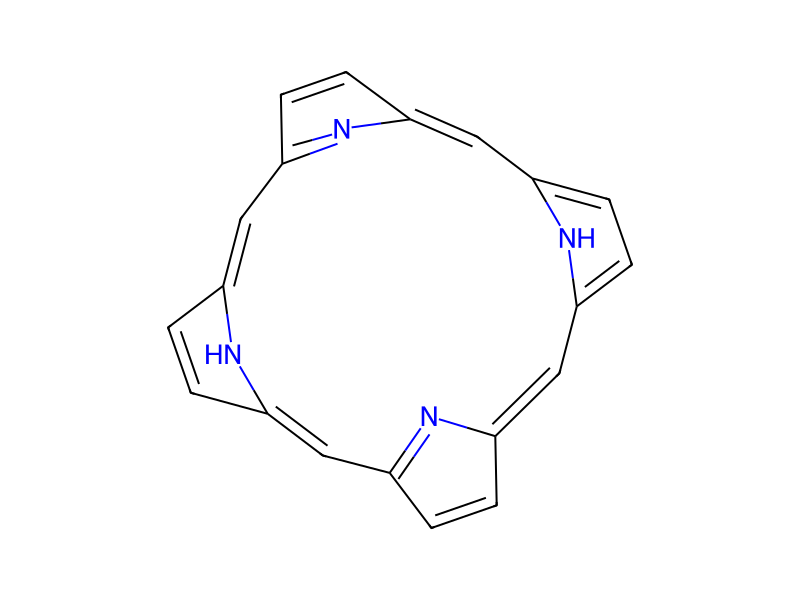
Product 1

Reagents, catalysts & solvents 1

Procedure
A 1:1.1 molar solution of porphyrin compound (VIII) (50 milligrams, 36.5 millimoles) to Cu(OAc)2.H2O (8 milligrams, 40 millimoles) to Cu(OAc)2H2O was prepared by dissolving the two compounds in methanol. The resulting purple solution was stirred for 20 minutes during which time the color turned to red. The solvent was then removed by rotary evaporation. The resulting residue was dissolved in dichloromethane to make an organic phase, which was washed with water and then dried over anhydrous sodium sulfate. The solvent of the organic phase was removed by rotary evaporation, leaving a red copper porphyrin compound. The compound was re-dissolved in dichloromethane and purified on a silica pad eluting with a 3:1:1 solvent mixture of hexane to dichloromethane to acetone. The solvent of the organic phase was removed by rotary evaporation, leaving 36 milligrams of the copper porphyrin compound (IX) (70% yield).
Workup
- customThe solvent was then removed by rotary evaporation
- dissolutionThe resulting residue was dissolved in dichloromethane
- washwas washed with water
- dry with materialdried over anhydrous sodium sulfate
- customThe solvent of the organic phase was removed by rotary evaporation
Sources & evidence
- ORD record
- ord-c1af84668da3419cbc0b1e439b51bbdd
- Source dataset
- uspto-grants-2006_02
- Patent number
- US06995260B2
Reaction notes
Loading…