Sodium Azide → HCID 22242898, compound
Reaction equation
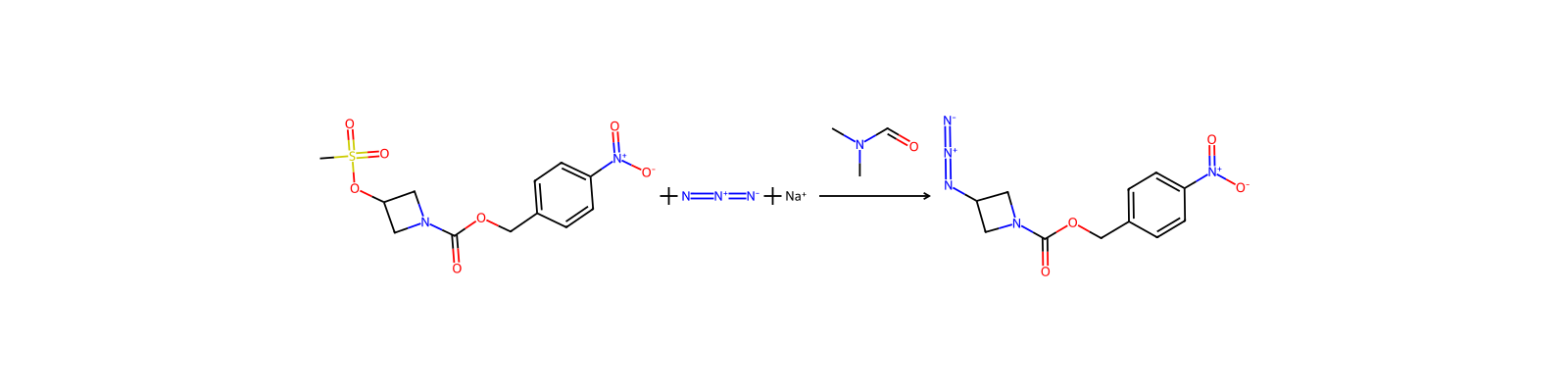
CS(O[CH:6]1[CH2:9][N:8]([C:10]([O:12][CH2:13][C:14]2[CH:19]=[CH:18][C:17]([N+:20]([O-:22])=[O:21])=[CH:16][CH:15]=2)=[O:11])[CH2:7]1)(=O)=O.[N-:23]=[N+:24]=[N-:25].[Na+]>CN(C)C=O>[N:23]([CH:6]1[CH2:9][N:8]([C:10]([O:12][CH2:13][C:14]2[CH:19]=[CH:18][C:17]([N+:20]([O-:22])=[O:21])=[CH:16][CH:15]=2)=[O:11])[CH2:7]1)=[N+:24]=[N-:25]Participants
Reactant 2


Product 1

Reagents, catalysts & solvents 1

Conditions
- Temperature
- 100 °C
Procedure
To a solution of 3-methanesulfonyloxy-1-(p-nitrobenzyloxycarbonyl)azetidine (4.63 g, 14.0 mmol) (obtained as described in Reference Example 54(2)) in dimethylformamide (140 ml) was added sodium azide (1.37 g, 21.0 mmol), and the mixture was stirred in an oil bath (100° C.) for 4 hours. After checking the completion of the reaction, the reaction mixture was partitioned between ethyl acetate and 10% aqueous sodium chloride solution. The organic layer was washed with saturated aqueous sodium chloride solution, dried over anhydrous sodium sulfate, filtered and concentrated under reduced pressure. The residue was purified by chromatography on a silica gel column using n-hexane:ethyl acetate (2:1→1:1) as the eluant to afford 3-azido-1-(p-nitrobenzyloxycarbonyl)azetidine (2.15 g, yield 55%) as pale yellow crystals.
Workup
- customthe completion of the reaction
- customthe reaction mixture was partitioned between ethyl acetate and 10% aqueous sodium chloride solution
- washThe organic layer was washed with saturated aqueous sodium chloride solution
- dry with materialdried over anhydrous sodium sulfate
- filtrationfiltered
- concentrationconcentrated under reduced pressure
- customThe residue was purified by chromatography on a silica gel column
Sources & evidence
- ORD record
- ord-e7bc774f853649a788db06976045a7a6
- Source dataset
- uspto-grants-2006_02
- Patent number
- US07001897B2
Reaction notes
Loading…