Succinic anhydride → 4-Oxo-4-{[2-(pyridin-2-yl)ethyl]amino}butanoic acid
Reaction equation

[C:1]1(=[O:7])[O:6][C:4](=[O:5])[CH2:3][CH2:2]1.[NH2:8][CH2:9][CH2:10][C:11]1[CH:16]=[CH:15][CH:14]=[CH:13][N:12]=1>ClCCl.CN(C1C=CN=CC=1)C>[O:7]=[C:1]([NH:8][CH2:9][CH2:10][C:11]1[CH:16]=[CH:15][CH:14]=[CH:13][N:12]=1)[CH2:2][CH2:3][C:4]([OH:6])=[O:5]Participants
5
Reactant 2

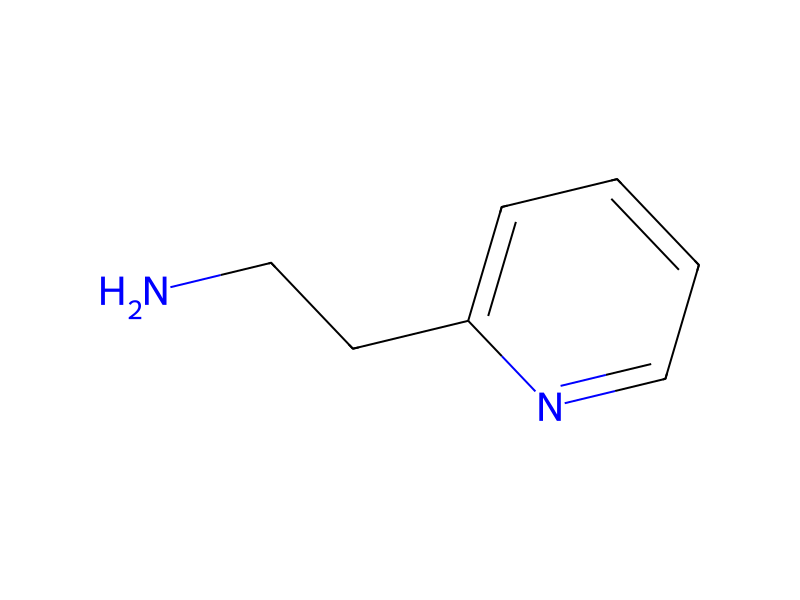
Product 1

Reagents, catalysts & solvents 2


Procedure
To a solution of 5.0 g (50 mmol) of succinic anhydride in 50 mL of dichloromethane was added 550 mg of DMAP and 6.1 g (50 mmol) of 2-(2'-aminoethyl)pyridine. An exothermic reaction resulted. The reaction was refluxed for 1 h and cooled to room temperature and stirred for 48 h. The reaction is worked up by concentrated in vacuo; the resulting solid was dissolved in pH 4 buffer and extracted three times with 4:1 ethyl acetate/tetrahydrofuran after the aqueous solution had been saturated with ammonium sulfate. The organic layer was dried over sodium sulfate and concentrated in vacuo to give a residue. The residue was recrystallized from ethyl acetate/methanol to give 5.5 g (50%) of 4-oxo-4-[[2-(2-pyridinyl)ethyl]amino]butanoic acid.
Workup
- customAn exothermic reaction
- customresulted
- temperatureThe reaction was refluxed for 1 h
- concentrationby concentrated in vacuo
- dissolutionthe resulting solid was dissolved in pH 4 buffer
- extractionextracted three times with 4:1 ethyl acetate/tetrahydrofuran after the aqueous solution
- dry with materialThe organic layer was dried over sodium sulfate
- concentrationconcentrated in vacuo
- customto give a residue
- customThe residue was recrystallized from ethyl acetate/methanol
Sources & evidence
- ORD record
- ord-6e96873eedc24c9cb73dce19400b7e3a
- Source dataset
- uspto-grants-1992_06
- Patent number
- US05118677
Reaction notes
Loading…