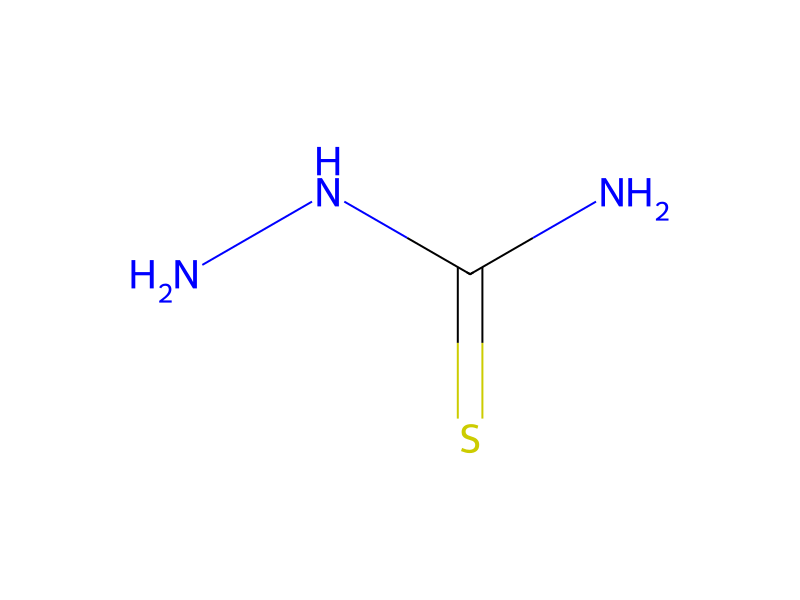
Thiosemicarbazide → 3-Formylbenzamidine-thiosemicarbazone hydrochloride
Reaction equation

[ClH:1].[CH:2]([C:4]1[CH:5]=[C:6]([CH:10]=[CH:11][CH:12]=1)[C:7]([NH2:9])=[NH:8])=O.[NH2:13][NH:14][C:15]([NH2:17])=[S:16]>CO.O.Cl>[ClH:1].[CH:2](=[N:13][NH:14][C:15]([NH2:17])=[S:16])[C:4]1[CH:5]=[C:6]([CH:10]=[CH:11][CH:12]=1)[C:7]([NH2:9])=[NH:8]Participants
6





Procedure
A solution of 1.84 g (~0.01 mol) of crude 3-formylbenzamidine hydrochloride (prepared analogously to Example 1b) in 10 ml of methanol is added dropwise to a solution of 0.91 g (0.01 mol) of thiosemicarbazide in 5 ml of water and 10 ml of 2N hydrochloric acid. This mixture is heated under reflux for 1 hour, cooled, filtered and concentrated to dryness by evaporation. The residue is recrystallised from methanol; m.p. 210° (with decomposition). The product contains 0.5 mol of water.
Workup
- temperatureThis mixture is heated
- temperatureunder reflux for 1 hour
- temperaturecooled
- filtrationfiltered
- concentrationconcentrated to dryness by evaporation
- customThe residue is recrystallised from methanol
Sources & evidence
- ORD record
- ord-89991516791b43cebedd0bdbbfd0cc70
- Source dataset
- uspto-grants-1992_06
- Patent number
- US05118709
Reaction notes
Loading…