Diisopropylamine → 4-[1,1-Dimethyl-2-oxo-3-(2-pyrazinyl)propoxy]benzonitrile
Reaction equation

C(C1C=CC(O)=C(C=1)C(C1[N+]([O-])=CC=NC=1)C=C(C)C)#N.CC1(C)CC(C2C=CC=CN=2)C2C=C(C(O)=O)C=CC=2O1.C([Li])CCC.C(NC(C)C)(C)C.[CH3:55][C:56]1[CH:61]=[N:60][CH:59]=[CH:58][N:57]=1.[C:62]([C:64]1[CH:78]=[CH:77][C:67]([O:68][C:69]([CH3:76])([CH3:75])[C:70](OCC)=[O:71])=[CH:66][CH:65]=1)#[N:63]>CCCCCC.O1CCCC1.O>[CH3:75][C:69]([CH3:76])([O:68][C:67]1[CH:77]=[CH:78][C:64]([C:62]#[N:63])=[CH:65][CH:66]=1)[C:70](=[O:71])[CH2:55][C:56]1[CH:61]=[N:60][CH:59]=[CH:58][N:57]=1Participants
Reactant 6
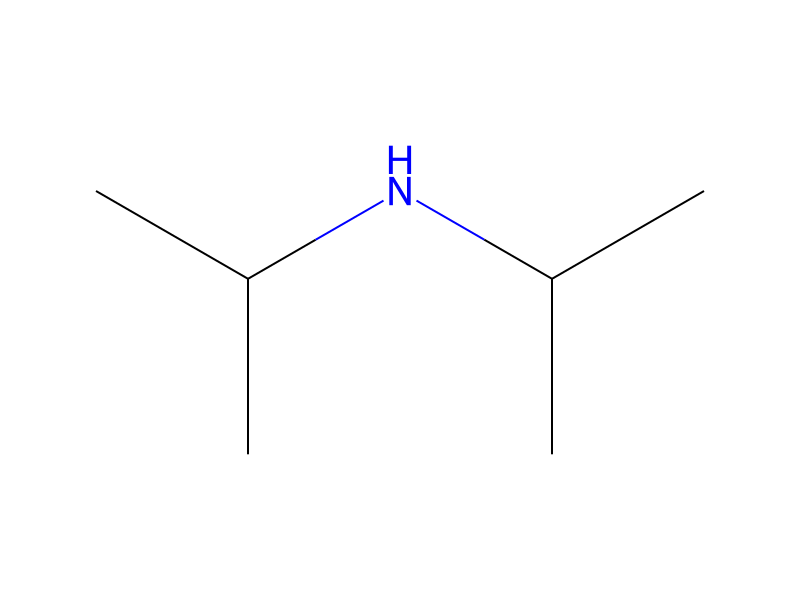 HCID 7912Diisopropylamine
 HCID 79762-Methylpyrazine
 HCID 205808Propanoic acid, 2-(4-cyanophenoxy)-2-methyl-, ethyl ester
 HCID 150389033,4-dihydro-2,2-dimethyl-4-(2-pyridyl)-2H-1-benzopyran-6-carboxylic acid
 HCID 198955986-[5-Cyano-2-hydroxy-alpha-(2-methylpropenyl)benzyl]pyrazine 1-oxide
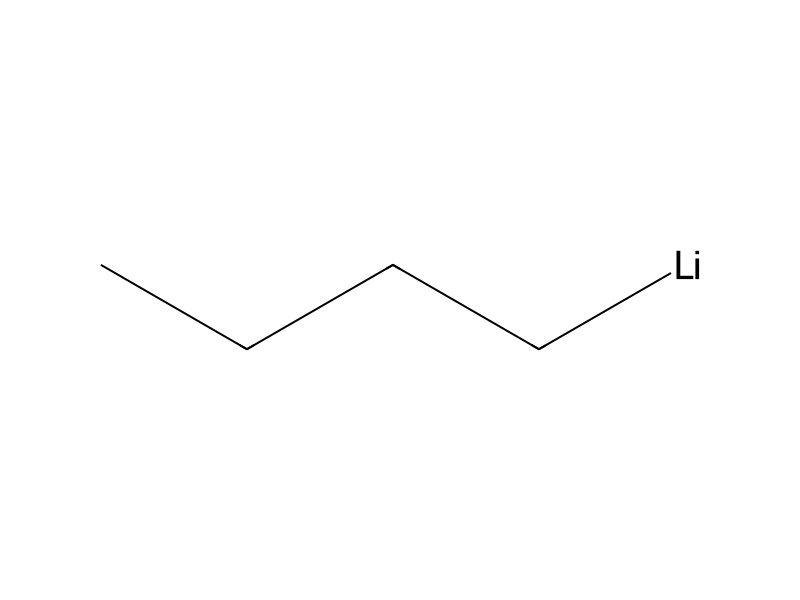 HCID 178418339Butyllithium
Product 1

Reagents, catalysts & solvents 3
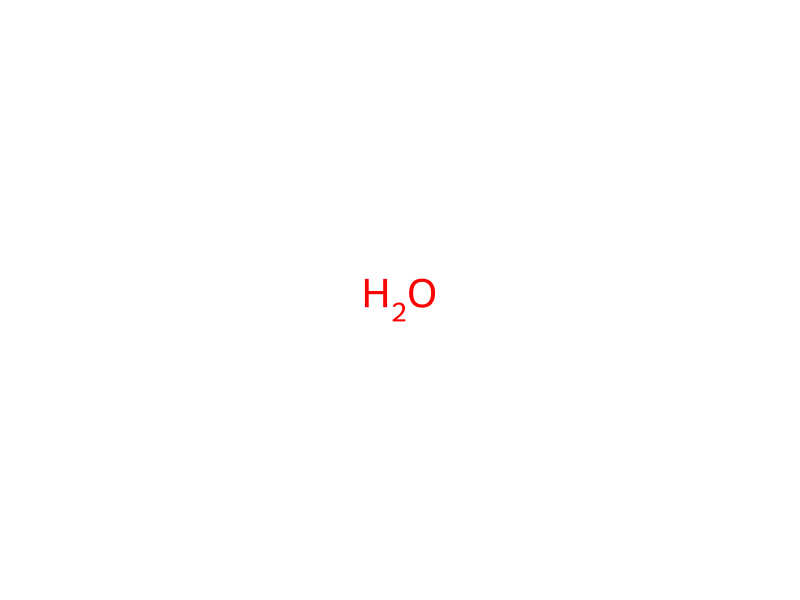
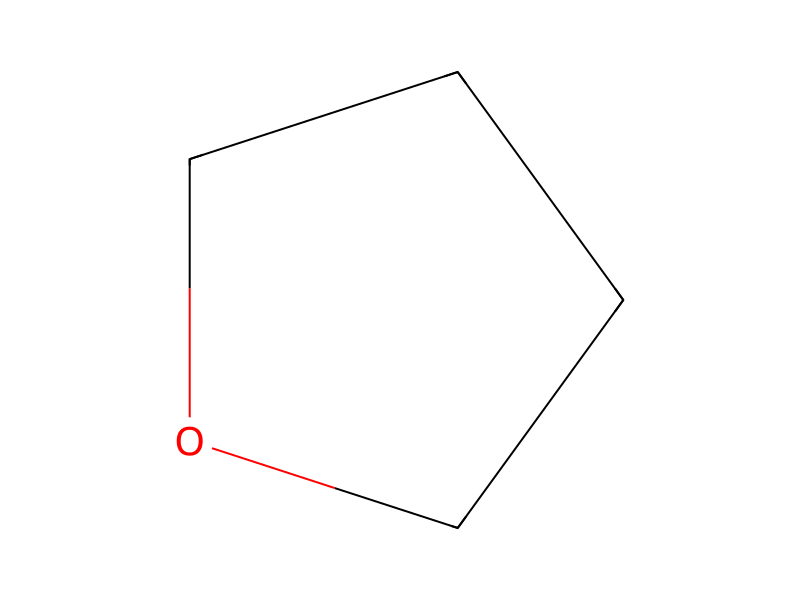
Conditions
- Temperature
- -78 °C
Procedure
The 6-[5-cyano-2-hydroxy-α-(2-methylpropenyl)benzyl]pyrazine 1-oxide used as the starting material was prepared as follows: (A) 10 ml of a 1.2M solution of butyllithium in n-hexane were added to a solution of 1.68 ml of diisopropylamine in 10 ml of tetrahydrofuran while stirring at -78° C. under a nitrogen atmosphere The solution was stirred for a further 15 minutes and then 0.94 g of 2-methylpyrazine in 20 ml of tetrahydrofuran was added. The solution was allowed to warm to 20° C. and was stirred for 1 hour. The solution was then cooled to -78° C, 2.33 g of ethyl 2-(4-cyanophenoxy)-2-methylpropionate in 30 ml of tetrahydrofuran were added and the mixture was allowed to warm to 20° C. The mixture was treated with 20 ml of water and the solvent was removed by evaporation. The residue was chromatographed on silica gel using ethyl acetate for the elution to give 1.37 g of 4-[1,1-dimethyl-2-oxo-3-(2pyrazinyl)propoxy]benzonitrile. (B) 0.107 g of sodium borohydride was added to a stirred suspension of 0.79 g of 4-[1,1-dimethyl-2-oxo-3-(2-pyrazinyl)propoxy]benzonitrile in 20 ml of ethanol. The mixture was stirred at 20° C. for 1.5 hours and was then diluted with water. The solution was extracted with ethyl acetate and the organic phase was then washed with sodium chloride solution and evaporated to give 0.5 g of 4-[2-hydroxy-1,1-dimethyl-3-(2-pyrazinyl)propoxy]benzonitrile in the form of a white solid of melting point 94°-95° C. (from diethyl ether). (C) 0.18 g of m-chloroperbenzoic acid was added to a stirred solution of 0.28 g of 4-[2-hydroxy-1,1-dimethyl-3(2-pyrazinyl)propoxy]benzonitrile in 10 ml of dichloromethane. After 16 hours a further 36 mg of m-chloroperbenzoic acid were added and the mixture was stirred for 24 hours. The solvents were then removed by evaporation and the residue was chromatographed on silica gel using diethyl ether/methanol (95:5) for the elution to give 0.09 g of 2-[3-(4-cyanophenoxy)-2-hydroxy-3-methylbutyl]pyrazine 1-oxide in the form of a white solid of melting point 103°-104° C. (from diethyl ether). (D) 0.32 g of methanesulphonyl chloride was added to a stirred solution of 0.84 g of 2-[3-(4-cyanophenoxy)-2-hydroxy-3-methylbutyl]pyrazine 1-oxide in 5 ml of pyridine. The mixture was stirred at 20° C. for 5 hours and a further 0.32 g of methanesulphonyl chloride was then added. The mixture was stirred at 20° C. for 70 hours and then poured into 2M hydrochloric acid. The solution was extracted with dichloromethane and the organic phase was washed with sodium chloride solution and evaporated. The residue was triturated with n-hexane to give 0.95 g of 2-[2-(4-cyanophenoxy)-2-methyl-3-(methylsulphonyl)propyl]pyrazine 1-oxide in the form of a white solid of melting point 146°-147° C. (E) 0.89 g of 2-[2-(4-cyanophenoxy)-2-methyl-3 -(methylsulphonyl)propyl]pyrazine 1-oxide was added to a solution of 71 mg of 80% sodium hydride in 5 ml of isopropanol and the mixture was stirred at 20° C. for 16 hours. The solvent o was removed by evaporation and the residue was partitioned between water and ethyl acetate. The organic solution was washed with sodium chloride solution and evaporated. The residue was chromatographed on silica gel using ethyl acetate/n-hexane (4:1) for the elution to give 0.5 g of (E)-2-[2-(4-cyanophenoxy)-2-methyl-1-butenyl]Pyrazine 1-oxide in the form of a white solid of melting point 107°-109° C. (F) 0.47 g of (E)-2-[2-(4-cyanophenoxy)-2-methyl-1-butenyl]pyrazine 1-oxide in 10 ml of toluene was heated to reflux for 16 hours. The cooled mixture was then filtered to give 0.4 g of 6-[5-cyano-2-hydroxy-α-(2methylpropenyl)benzyl]pyrazine 1-oxide in the form of a pale tan solid of melting point 212°-213° C.
Workup
- customwas prepared
- stirringwas stirred for a further 15 minutes
- temperatureto warm to 20° C.
- stirringwas stirred for 1 hour
- temperatureThe solution was then cooled to -78° C
- temperatureto warm to 20° C
- customthe solvent was removed by evaporation
- customThe residue was chromatographed on silica gel
- washfor the elution
Sources & evidence
- ORD record
- ord-bd7ee6457b6c47b2a5bd99ae8bc5cc8f
- Source dataset
- uspto-grants-1992_06
- Patent number
- US05118694
Reaction notes
Loading…