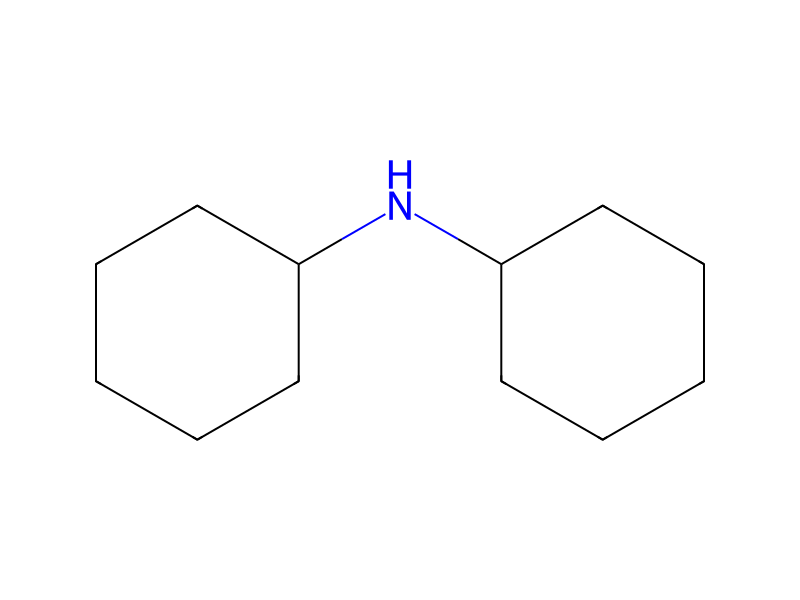
Dicyclohexylamine → 3-Hydroxy-2-cyclobuten-1-one dicyclohexylammonium salt
Reaction equation

[CH:1]1([NH:7][CH:8]2[CH2:13][CH2:12][CH2:11][CH2:10][CH2:9]2)[CH2:6][CH2:5][CH2:4][CH2:3][CH2:2]1.[C:14]1(=[O:19])[CH2:17][C:16](=[O:18])[CH2:15]1>C(OCC)(=O)C>[CH:8]1([NH2+:7][CH:1]2[CH2:2][CH2:3][CH2:4][CH2:5][CH2:6]2)[CH2:9][CH2:10][CH2:11][CH2:12][CH2:13]1.[OH:19][C:14]1[CH2:17][C:16](=[O:18])[CH:15]=1Participants
4
Reactant 2

Product 1

Reagents, catalysts & solvents 1

Procedure
A solution of 7.1 g of dicyclohexylamine (98 percent; 38.3 mmol) in 15 ml of ethyl acetate was instilled in a suspension of 3.0 g of 1,3-cyclobutanedione (97 percent; 34.6 mmol) in ethyl acetate (52.2 ml) at 20° C. in 15 minutes. After 1 hour of stirring at room temperature, the suspension was washed four times -with ethyl acetate and dried under vacuum. 9.4 g of the title product with a content of 94.7 percent (according to HPLC), corresponding to a yield of 96.7 percent, relative to cyclobutanedione, was obtained. Data for the title compound was:
Workup
- washthe suspension was washed four times -with ethyl acetate
- customdried under vacuum
Sources & evidence
- ORD record
- ord-c8b72b970a8846a1ab6e206c74b471db
- Source dataset
- uspto-grants-1992_06
- Patent number
- US05118861
Reaction notes
Loading…