Ammonia → 5-(1,1-Dimethylethyl)-N-methyl-1,3,4-thiadiazol-2-amine
Reaction equation

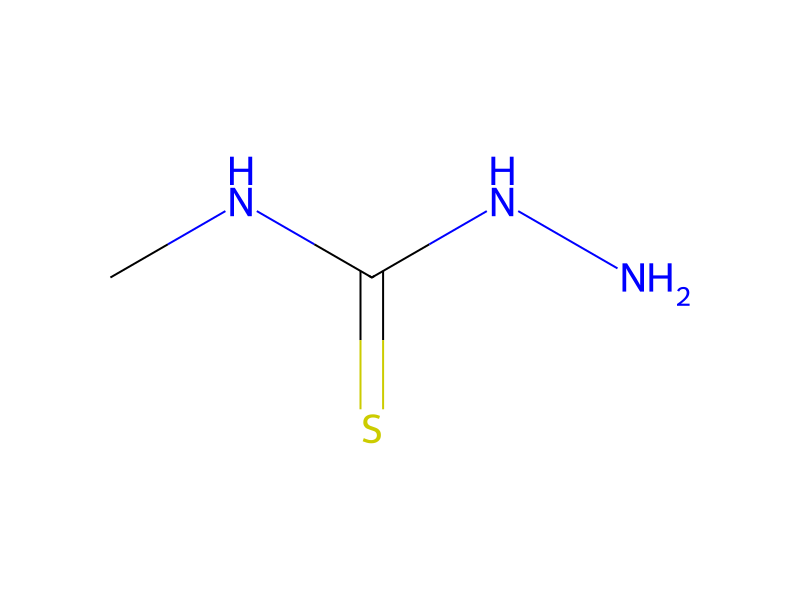
S(=O)(=O)(O)O.[C:6](O)(=O)[C:7]([CH3:10])([CH3:9])[CH3:8].[CH3:13][NH:14][C:15](=[S:18])[NH:16][NH2:17].N>C1(C)C=CC=CC=1.O>[C:7]([C:6]1[S:18][C:15]([NH:14][CH3:13])=[N:16][N:17]=1)([CH3:10])([CH3:9])[CH3:8]Participants






Conditions
- Temperature
- 70 °C
Procedure
Into a four-necked, 1-liter flask equipped with a stirrer, thermometer and a drying tube was charged a solution of 115% polyphosphoric acid (63.98 g) and 96.2% sulfuric acid (21.33 g). A solution of pivalic acid (21.48 g, 0.2107 mole) and toluene (1.82 g) was added followed by 4-methyl-3-thiosemicarbazide (22.1 g, 0.2102 mole). The mixture was stirred with the initial reaction exotherm being controlled with cooling if necessary such that the reaction temperature did not rise above 70° C. The reaction mixture was then maintained with stirring and heating for about 1 hour at 70° C. The reaction flask was then fitted with two dropping funnels. The first funnel contained 256 g of a solution consisting of 192 g of 115% polyphosphoric acid and 64 g of 96.2% sulfuric acid. The second funnel contained a mechanically stirred slurry of 4-methyl-3-thiosemicarbazide (66.3 g, 0.631 mole) in pivalic acid (64.45 g, 0.632 mole) and toluene (5.45 g). The contents of the two dropping funnels were added simultaneously to the stirred reaction mixture (reaction "heel") over a period of 45 minutes, the reaction temperature being maintained at 70° C. The temperature was then increased to 80° C. and held for about 1 hour. The contents of the flask were then poured slowly into a stirred mixture of 28% aqueous ammonia (445 ml), water (210 ml) and toluene (40 ml) contained in a 2-liter beaker. The temperature was allowed to rise to 75°-80° C. and the pH of the aqueous phase was adjusted to 6.1 by the addition of 150 ml of 28% ammonia. The aqueous and organic phases were separated while hot (75° C.). The product, 5-t-butyl-2-methylamino-1,3,4-thiadiazole was isolated as a yellow to orange solid in 98% yield, melting point 78°-80° C., by evaporation of the organic phase to dryness under reduced pressure.
Workup
- customInto a four-necked, 1-liter flask equipped with a stirrer
- customreaction exotherm
- temperaturewith cooling if necessary such that the reaction temperature
- customdid not rise above 70° C
- temperatureThe reaction mixture was then maintained
- stirringwith stirring
- customThe reaction flask was then fitted with two dropping funnels
- additionThe contents of the two dropping funnels were added simultaneously to the stirred reaction mixture (reaction "heel") over a period of 45 minutes
- temperaturethe reaction temperature being maintained at 70° C
- temperatureThe temperature was then increased to 80° C.
- customto rise to 75°-80° C.
- customThe aqueous and organic phases were separated while hot (75° C.)
Sources & evidence
- ORD record
- ord-faf0639466ff4938a699fa397b55686e
- Source dataset
- uspto-grants-1981_08
- Patent number
- US04283543
Reaction notes
Loading…