Ethanol → 4-Bromo-5-fluoro-isoquinoline
Reaction equation

N[C:2]1[CH:11]=[CH:10][CH:9]=[C:8]2[C:3]=1[C:4]([Br:12])=[CH:5][N:6]=[CH:7]2.CCO.N([O-])=O.[Na+].[F:20][B-](F)(F)F.[H+]>O.CCOCC>[Br:12][C:4]1[C:3]2[C:8](=[CH:9][CH:10]=[CH:11][C:2]=2[F:20])[CH:7]=[N:6][CH:5]=1Participants

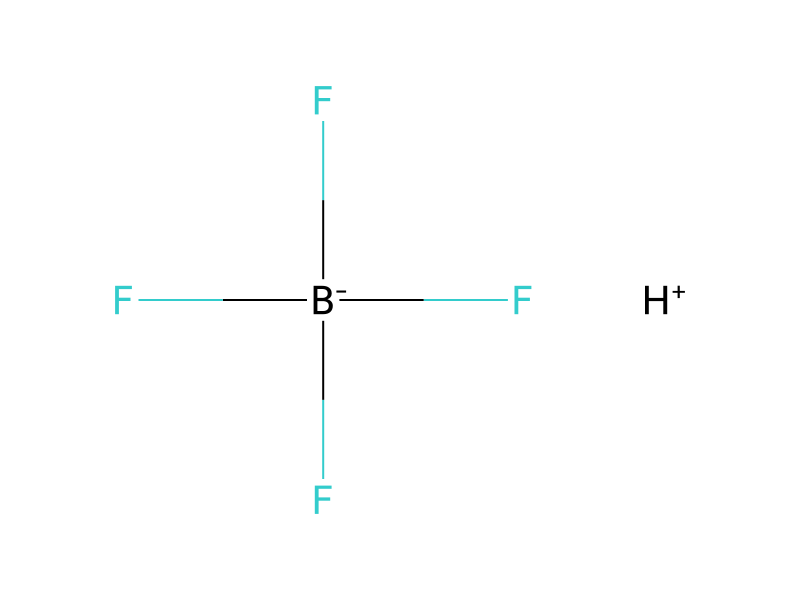





Conditions
- Temperature
- 0 °C
Procedure
5-Amino-4-bromo-isoquinoline (see Gordon et al., J. Heterocycl. Chem., 4, 1967, 410-411) (1.86 g, 8.34 mmol) was stirred in 48% fluoroboric acid (15 mL)/EtOH (15 mL) until completely dissolved. The solution was cooled to 0° C., and sodium nitrite (660 mg, 9.59 mmol) in H2O (1 mL) was added dropwise. The solution was diluted with Et2O (30 mL), and the tan diazonium fluoroborate salt was collected by filtration and dried under vacuum. The solid was placed in a flask and carefully heated over a flame to expel nitrogen. The dark brown residue was diluted with 10% NaOH and extracted with chloroform. Organics were washed with brine, dried over MgSO4, and concentrated in vacuo. Purification by silica gel chromatography (40% to 50% ethyl acetate/ hexanes) gave 798 mg (42%) of 4-bromo-5-fluoro-isoquinoline as a white solid. 1H NMR (300 MHz, CDCl3) δ 9.36 (d, 1H, J=2.4 Hz), 8.74 (s, 1H), 8.07-8.11 (m, 1H), 7.70-7.80 (m, 2H). Anal. (C9H5BrFN) C, H, N.
Workup
- dissolutionuntil completely dissolved
- filtrationthe tan diazonium fluoroborate salt was collected by filtration
- customdried under vacuum
- customThe solid was placed in a flask
- temperaturecarefully heated over
- temperaturea flame
- additionThe dark brown residue was diluted with 10% NaOH
- extractionextracted with chloroform
- washOrganics were washed with brine
- dry with materialdried over MgSO4
- concentrationconcentrated in vacuo
- customPurification by silica gel chromatography (40% to 50% ethyl acetate/ hexanes)
Sources & evidence
- ORD record
- ord-f42f2937913249dab2a5e7f73e703634
- Source dataset
- uspto-grants-2005_07
- Patent number
- US06919461B2
Reaction notes
Loading…