4-Bromoaniline → HCID 22346912, compound
Reaction equation

[F:1][C:2]1[CH:10]=[C:9]([C:11]([F:14])([F:13])[F:12])[CH:8]=[CH:7][C:3]=1[C:4](Cl)=[O:5].[Br:15][C:16]1[CH:22]=[CH:21][C:19]([NH2:20])=[CH:18][CH:17]=1.C(N(CC)C(C)C)(C)C>ClCCl>[Br:15][C:16]1[CH:22]=[CH:21][C:19]([NH:20][C:4](=[O:5])[C:3]2[CH:7]=[CH:8][C:9]([C:11]([F:14])([F:13])[F:12])=[CH:10][C:2]=2[F:1])=[CH:18][CH:17]=1Participants
Reactant 3
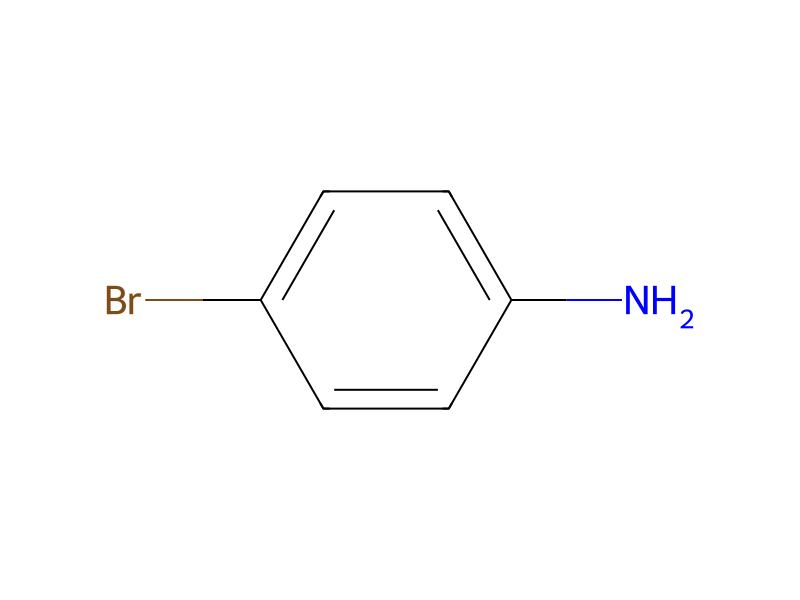


Product 1

Reagents, catalysts & solvents 1

Procedure
A solution of 2-fluoro-4-(trifluoromethyl)benzoyl chloride (5.05 g, 0.0223 mol) and 4-bromoaniline (3.83 g, 0.0223 mol) in anhydrous dichloromethane (150 mL) was cooled to 0° C. and N,N-diisopropylethylamine (4.26 mL, 0.0245 mol) was added under nitrogen atmosphere dropwise. The resulting mixture was stirred at ambient temperature for 24 hours, concentrated and the residue was partitioned between ethyl acetate (120 mL) and water (100 mL). The organic phase was washed with brine, dried with magnesium sulfate and concentrated. The residue was suspended in cold n-heptane (50 mL) and the precipitate was collected by filtration and dried to yield N1-(4-bromophenyl)-2-fluoro-4-(trifluoromethyl)benzamide (7.1 g, 0.0196 mol) as a white solid.
Workup
- concentrationconcentrated
- customthe residue was partitioned between ethyl acetate (120 mL) and water (100 mL)
- washThe organic phase was washed with brine
- dry with materialdried with magnesium sulfate
- concentrationconcentrated
- filtrationthe precipitate was collected by filtration
- customdried
Sources & evidence
- ORD record
- ord-56661b40f46b48359412f14f62c72dd5
- Source dataset
- uspto-grants-2005_07
- Patent number
- US06921763B2
Reaction notes
Loading…