Triphenylphosphine dibromide → HCID 21874554, compound
Reaction equation

[CH2:1]([C:3]1[CH:8]=[C:7]([CH2:9]O)[CH:6]=[CH:5][N:4]=1)[CH3:2].[Br:11]P(Br)(C1C=CC=CC=1)(C1C=CC=CC=1)C1C=CC=CC=1>ClCCl>[CH2:1]([C:3]1[CH:8]=[C:7]([CH2:9][Br:11])[CH:6]=[CH:5][N:4]=1)[CH3:2]Participants
Reactant 2
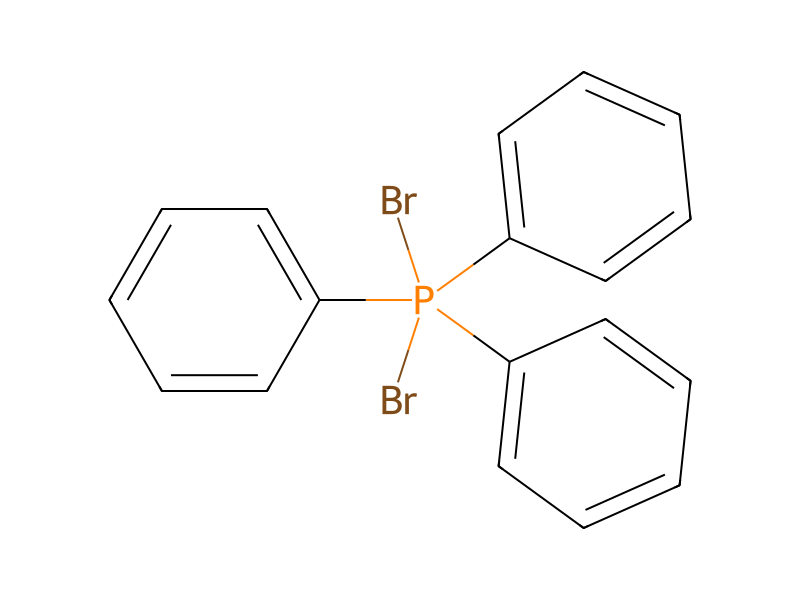

Product 1

Reagents, catalysts & solvents 1

Conditions
- Temperature
- 20 °C
Procedure
A solution of 0.3 g of 2-ethyl-4-(hydroxymethyl)pyridine in 3.5 ml of dichloromethane is added dropwise to a solution of 1.25 g of dibromotriphenylphosphorane in 4 ml of dichloromethane, under an inert atmosphere of argon at a temperature in the region of 0° C. The mixture is stirred to a temperature in the region of 20° C. over about 1 hour. The reaction medium is taken up in 50 ml of dichloromethane and then washed with 3×50 ml of water. The organic phase is dried over magnesium sulfate, filtered and then concentrated to dryness under reduced pressure. The residue thus obtained is purified by flash chromatography using a cartridge 20 mm in diameter packed with 10 g of 20-40 μm conditioned silica, and then eluted with a mixture (cyclohexane/ethyl acetate) (9/1) (v/v), at a flow rate of 8 ml/minute. The fractions between 80 and 120 ml are concentrated under reduced pressure. 0.062 g of 2-ethyl-4-(bromomethyl)pyridine is thus obtained.
Workup
- washwashed with 3×50 ml of water
- dry with materialThe organic phase is dried over magnesium sulfate
- filtrationfiltered
- concentrationconcentrated to dryness under reduced pressure
- customThe residue thus obtained
- customis purified by flash chromatography
- washeluted with a mixture (cyclohexane/ethyl acetate) (9/1) (v/v), at a flow rate of 8 ml/minute
- concentrationThe fractions between 80 and 120 ml are concentrated under reduced pressure
Sources & evidence
- ORD record
- ord-fd7ecbc290be46c3beed9a3b35f7a673
- Source dataset
- uspto-grants-2008_04
- Patent number
- US07354933B2
Reaction notes
Loading…