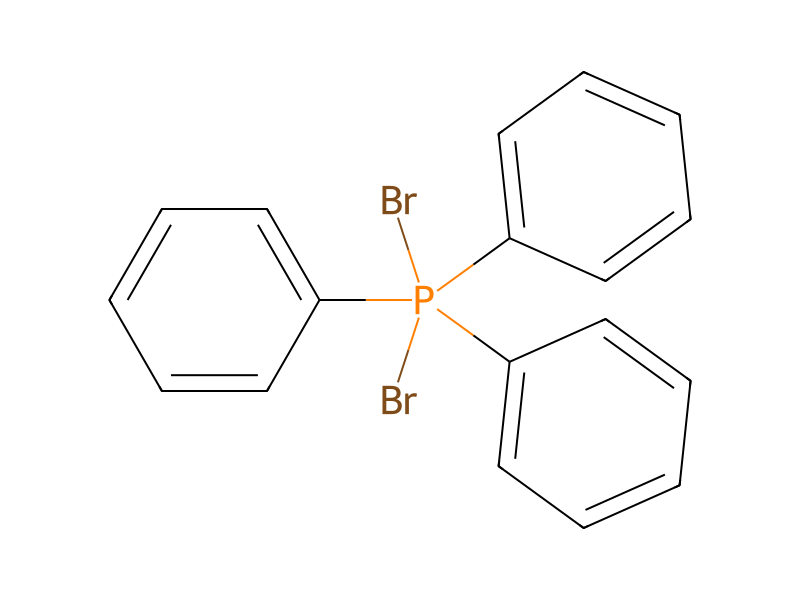
Triphenylphosphine dibromide → HCID 59694328, compound
Reaction equation

[Br:1][C:2]1[CH:7]=[C:6]([CH2:8]O)[CH:5]=[C:4]([Br:10])[N:3]=1.[Br:11]P(Br)(C1C=CC=CC=1)(C1C=CC=CC=1)C1C=CC=CC=1>ClCCl>[Br:1][C:2]1[CH:7]=[C:6]([CH2:8][Br:11])[CH:5]=[C:4]([Br:10])[N:3]=1Participants
Reactant 2

Product 1

Reagents, catalysts & solvents 1

Conditions
- Temperature
- 20 °C
Procedure
A solution of 0.5 g of 2,6-dibromo-4-(hydroxymethyl)pyridine in 7 ml of dichloromethane is added dropwise to a solution of 0.95 g of dibromotriphenylphosphorane in 5 ml of dichloromethane, under an inert atmosphere of argon at a temperature in the region of 0° C. The mixture is stirred to a temperature in the region of 20° C. over about 2 hours. The reaction medium is taken up in 100 ml of dichloromethane and then washed with 100 ml of water. The organic phase is dried over magnesium sulfate, filtered and then concentrated to dryness under reduced pressure. The residue thus obtained is purified by flash chromatography using a cartridge 37 mm in diameter packed with 50 g of 20-40 μm conditioned silica, and then eluted with a mixture (cyclohexane/ethyl acetate) (9/1) (v/v), at a flow rate of 8 ml/minute. The fractions between 135 and 200 ml are concentrated under reduced pressure. 0.349 g of 2,6-dibromo-4-(bromomethyl)pyridine is thus obtained.
Workup
- washwashed with 100 ml of water
- dry with materialThe organic phase is dried over magnesium sulfate
- filtrationfiltered
- concentrationconcentrated to dryness under reduced pressure
- customThe residue thus obtained
- customis purified by flash chromatography
- washeluted with a mixture (cyclohexane/ethyl acetate) (9/1) (v/v), at a flow rate of 8 ml/minute
- concentrationThe fractions between 135 and 200 ml are concentrated under reduced pressure
Sources & evidence
- ORD record
- ord-3a76a31716b94dd4bcf6f11b95352ac4
- Source dataset
- uspto-grants-2008_04
- Patent number
- US07354933B2
Reaction notes
Loading…