Water → 6-(4-Nitrobenzylthio)-purine
Reaction equation

O.[SH:2][C:3]1[N:11]=[CH:10][N:9]=[C:8]2[C:4]=1[NH:5][CH:6]=[N:7]2.O.[N+:13]([C:16]1[CH:23]=[CH:22][C:19]([CH2:20]Br)=[CH:18][CH:17]=1)([O-:15])=[O:14]>CN(C=O)C>[N+:13]([C:16]1[CH:23]=[CH:22][C:19]([CH2:20][S:2][C:3]2[N:11]=[CH:10][N:9]=[C:8]3[C:4]=2[NH:5][CH:6]=[N:7]3)=[CH:18][CH:17]=1)([O-:15])=[O:14]Participants
5
Reactant 3


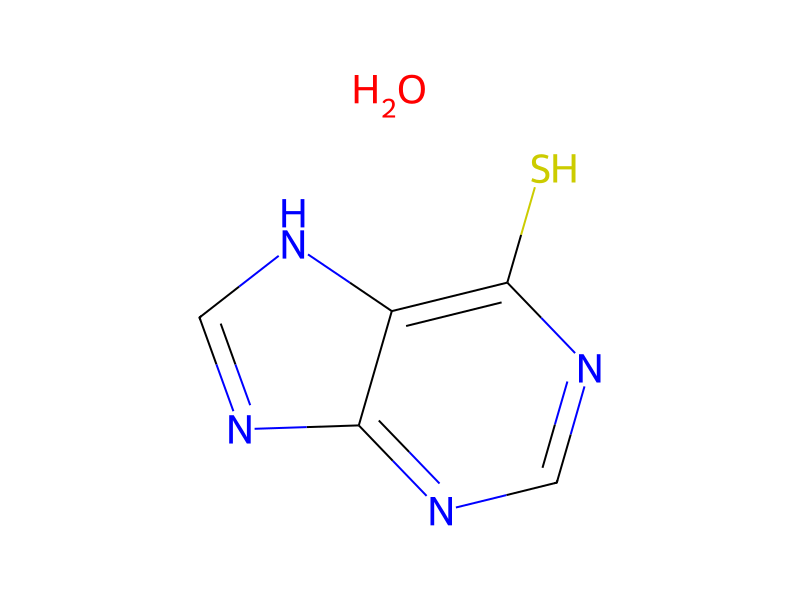
Product 1

Reagents, catalysts & solvents 1

Procedure
After stirring a mixture of 30 mmol of 6-mercaptopurine monohydrate (5.12 g) and 30 mmol of water-free K2CO3 (4.12 g) in 25 mL of dry DMF for 5 minutes, 30 mmol of 4-nitrobenzylbromide (6.48 g) was added. After stirring for 4 h, 200 mL of H2O was added. The obtained solid was filtered and washed with EtOAc and CH2Cl2, followed by drying under vacuum. Yield: 91%.—White powder.
Workup
- stirringAfter stirring for 4 h
- filtrationThe obtained solid was filtered
- washwashed with EtOAc and CH2Cl2
- customby drying under vacuum
Sources & evidence
- ORD record
- ord-926a290d66c74628a4ed90a021b135ad
- Source dataset
- uspto-grants-2008_04
- Patent number
- US07358235B2
Reaction notes
Loading…