Phosphorus pentachloride → 2-Chloro-5-(trifluoromethyl)pyridine
Reaction equation

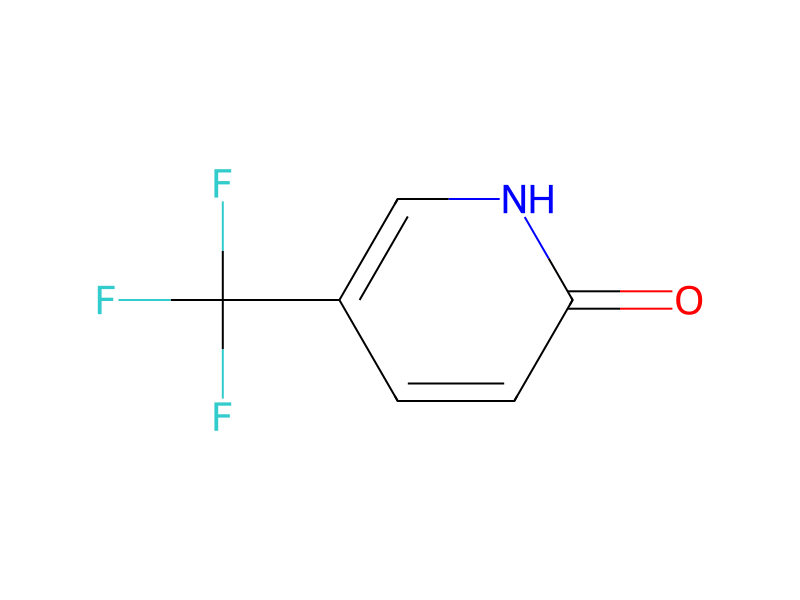
[F:1][C:2]([F:11])([F:10])[C:3]1[CH:4]=[CH:5][C:6](=O)[NH:7][CH:8]=1.P(Cl)(Cl)(Cl)(Cl)[Cl:13]>P(Cl)(Cl)(Cl)=O>[Cl:13][C:6]1[CH:5]=[CH:4][C:3]([C:2]([F:11])([F:10])[F:1])=[CH:8][N:7]=1Participants
4
Reactant 2

Product 1

Reagents, catalysts & solvents 1

Procedure
25 g of this 5-trifluoromethyl-2-pyridone was then added to 100 cc of phosphorous oxychloride and 40 g of phosphorous pentachloride and heated to 100° C. to 8 hours, the excess phosphorous oxychloride removed by distillation at reduced pressure and the residue remaining taken up in 200 cc of water. The pH was adjusted to 7 with sodium hydroxide. Extraction of the solution three times with 100 cc of with chloroform gave 2-chloro-5-trifluoromethylpyridine on removal of the solvent.
Workup
- temperatureheated to 100° C. to 8 hours
- customthe excess phosphorous oxychloride removed by distillation at reduced pressure
- extractionExtraction of the solution three times with 100 cc of with chloroform
Sources & evidence
- ORD record
- ord-01caf550347f46449bc4b2efe713ef96
- Source dataset
- uspto-grants-1980_10
- Patent number
- US04230864
Reaction notes
Loading…