Hydrochloric Acid → 3-(Trifluoromethyl)benzaldehyde
Reaction equation
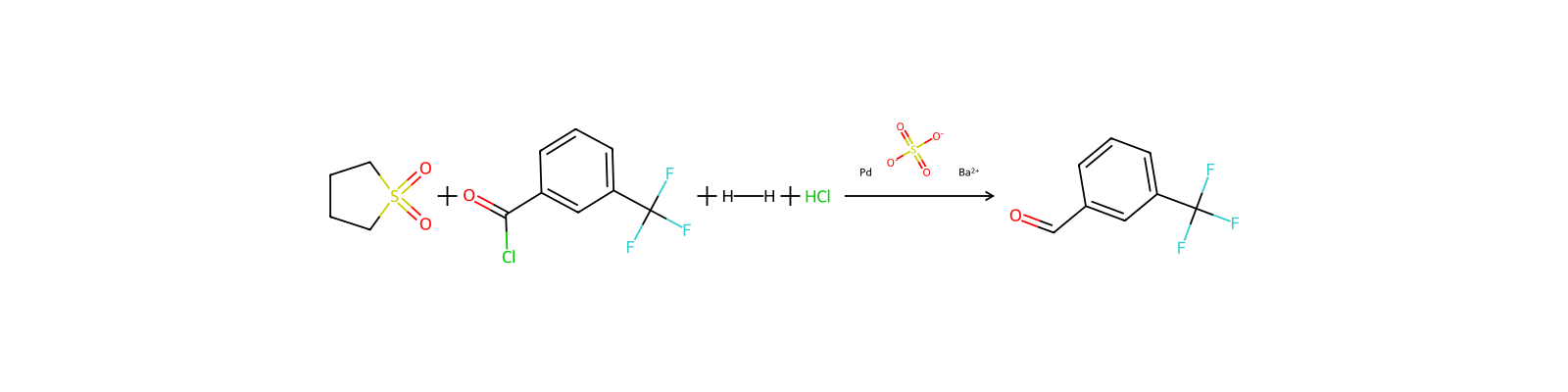
S1(CCCC1)(=O)=O.[F:8][C:9]([F:20])([F:19])[C:10]1[CH:11]=[C:12]([CH:16]=[CH:17][CH:18]=1)[C:13](Cl)=[O:14].[H][H].Cl>[Pd].[O-]S([O-])(=O)=O.[Ba+2]>[F:8][C:9]([F:19])([F:20])[C:10]1[CH:11]=[C:12]([CH:16]=[CH:17][CH:18]=1)[CH:13]=[O:14]Participants
6






Procedure
In a three-necked flask equipped with a stirrer, a gas inlet tube and a reflux condenser, 250 g of sulpholane (thiolane-S-dioxide), 5 g of Pd-BaSO4 (Pd content: 5% by weight) and 100 g (0.48 mol) of 3-trifluoromethylbenzoyl chloride from Example 1 are heated at 140° C. while hydrogen is being passed through. The elimination of hydrogen chloride which commenced immediately was complete in 3 hours. The 3-trifluoromethylbenzaldehyde formed was distilled off without the catalyst having been filtered off. Boiling point 69°-70° C./20 mbars, nD20 1.4648, 70 g; Yield: 84% of theory.
Workup
- customIn a three-necked flask equipped with a stirrer, a gas inlet tube and a reflux condenser
Sources & evidence
- ORD record
- ord-05ebb4a87ac542d8ad3bd65a7d6ce868
- Source dataset
- uspto-grants-1983_12
- Patent number
- US04420433
Reaction notes
Loading…