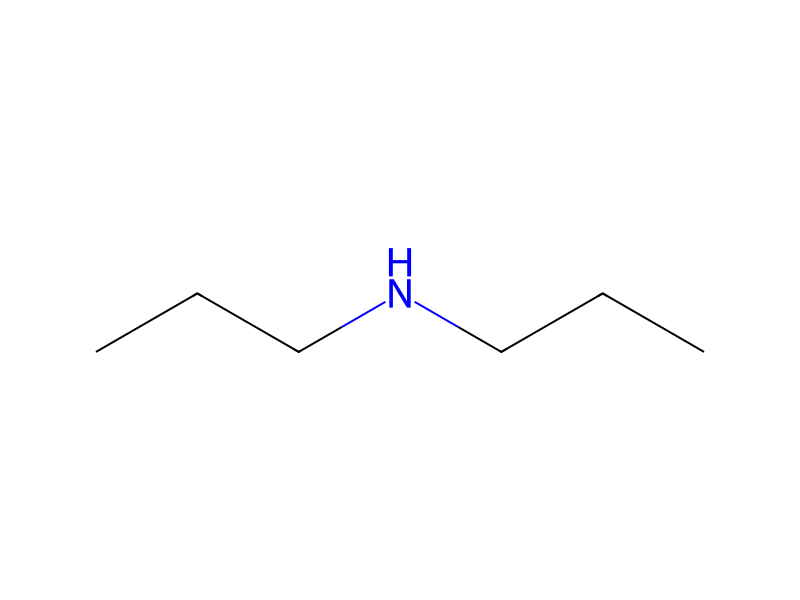
Dipropylamine → Diethyl (dipropylamino)propanedioate
Reaction equation

[CH2:1]([NH:4][CH2:5][CH2:6][CH3:7])[CH2:2][CH3:3].Br[CH:9]([C:15]([O:17][CH2:18][CH3:19])=[O:16])[C:10]([O:12][CH2:13][CH3:14])=[O:11]>C1C=CC=CC=1>[CH2:1]([N:4]([CH:9]([C:10]([O:12][CH2:13][CH3:14])=[O:11])[C:15]([O:17][CH2:18][CH3:19])=[O:16])[CH2:5][CH2:6][CH3:7])[CH2:2][CH3:3]Participants
4
Reactant 2

Product 1

Reagents, catalysts & solvents 1

Procedure
Di-n-propylamine (15.2 g) and diethyl bromomalonate (17.9) were dissolved in dry benzene (90 ml), and the mixture was heated under reflux for 7 hours with stirring. The reaction mixture was worked up in the same way as in Example 2, (1). The resulting residue was chromatographed on a silica gel column using benzene/ethyl acetate (20:1) as an eluent to give 16.9 g (yield 87%) of diethyl di-n-propylaminomalonate.
Workup
- temperaturethe mixture was heated
- temperatureunder reflux for 7 hours
- customThe resulting residue was chromatographed on a silica gel column
Sources & evidence
- ORD record
- ord-bbe3ff12e8c84d60a909bb43f5db12d6
- Source dataset
- uspto-grants-1983_12
- Patent number
- US04421914
Reaction notes
Loading…