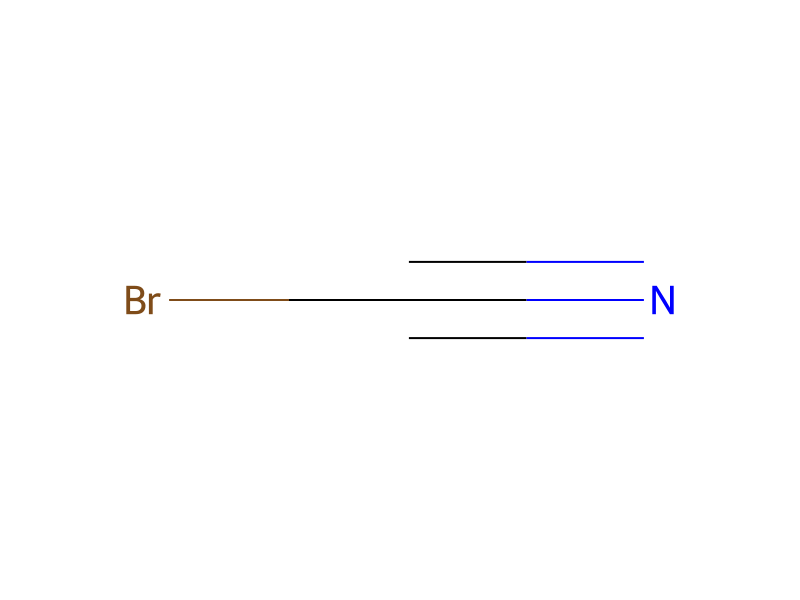
Cyanogen Bromide → 5,6-difluoro-1H-1,3-benzodiazol-2-amine
Reaction equation

[NH2:1][C:2]1[CH:7]=[C:6]([F:8])[C:5]([F:9])=[CH:4][C:3]=1[NH2:10].[N:11]#[C:12]Br.C(=O)(O)[O-].[Na+]>O>[F:8][C:6]1[C:5]([F:9])=[CH:4][C:3]2[NH:10][C:12]([NH2:11])=[N:1][C:2]=2[CH:7]=1Participants
Reactant 3


Product 1

Reagents, catalysts & solvents 1

Procedure
The procedure used was similar to that reported in J. Med. Chem. 40:811-818, 1997. A solution of 1,2-diamino-4,5-difluorobenzene (500 mg, 3.47 mmol) in water (5 mL) was cooled to 0° C. and then treated with a solution of cyanogen bromide (0.83 mL, 4.16 mmol, 5 M in acetonitrile) and solid sodium bicarbonate (583 mg, 6.94 mmol). The solution was stirred at rt overnight and was then concentrated in vacuo. The dark residue was suspended in ethanol and heated at reflux for 15 minutes. The hot suspension was filtered, rinsing with hot ethanol, and the filtrate was concentrated in vacuo to afford 5,6-difluoro-1H-benzimidazol-2-amine (580 mg, 59%), which was used in the next step without further purification. LC-MS m/z 170.2 (MH+), ret. time 0.85 min; 1H NMR (300 MHz, DMSO-d6) δ 6.30 (br s, 2H), 7.06 (dd, 2H), 10.79 (br s, 1H).
Workup
- concentrationwas then concentrated in vacuo
- temperatureheated
- temperatureat reflux for 15 minutes
- filtrationThe hot suspension was filtered
- washrinsing with hot ethanol
- concentrationthe filtrate was concentrated in vacuo
Sources & evidence
- ORD record
- ord-465fd2d882a746df95e895474cfd3220
- Source dataset
- uspto-grants-2011_09
- Patent number
- US08013166B2
Reaction notes
Loading…