Cyclohexylamine → 4-Bromo-N-cyclohexyl-2-fluorobenzamide
Reaction equation

[Br:1][C:2]1[CH:10]=[CH:9][C:5]([C:6](Cl)=[O:7])=[C:4]([F:11])[CH:3]=1.C(N(CC)CC)C.[CH:19]1([NH2:25])[CH2:24][CH2:23][CH2:22][CH2:21][CH2:20]1>C(Cl)Cl>[Br:1][C:2]1[CH:10]=[CH:9][C:5]([C:6]([NH:25][CH:19]2[CH2:24][CH2:23][CH2:22][CH2:21][CH2:20]2)=[O:7])=[C:4]([F:11])[CH:3]=1Participants
5
Reactant 3


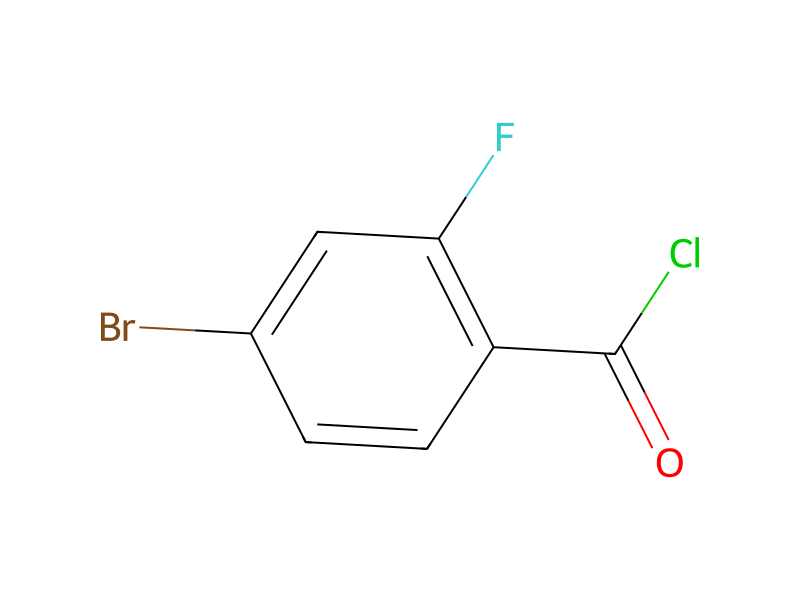
Product 1

Reagents, catalysts & solvents 1

Procedure
Dissolve 4-bromo-2-fluoro-benzoyl chloride (1 g, 4.21 mmol) in DCM and cool the solution in an ice bath. Add triethylamine (0.87 mL, 6.32 mmol) and cyclohexylamine (502 mg, 5.1 mmol) and stir the mixture at ambient temperature for 2 h. Partition the reaction mixture between brine and DCM. Dry the organic layer over Na2SO4, filter and concentrate in vacuo to give the desired intermediate as a white solid (1.24 g, 98%).
Workup
- temperaturecool the solution in an ice bath
- customPartition the reaction mixture between brine and DCM
- dry with materialDry the organic layer over Na2SO4
- filtrationfilter
- concentrationconcentrate in vacuo
Sources & evidence
- ORD record
- ord-7239490edb344e0b8f836e1eae6e75fb
- Source dataset
- uspto-grants-2011_09
- Patent number
- US08022062B2
Reaction notes
Loading…