5-Bromo-N'-(chloroacetyl)-3-pyridinecarbohydrazide → 3-Bromo-5-[5-(chloromethyl)-1,3,4-oxadiazol-2-yl]pyridine
Reaction equation
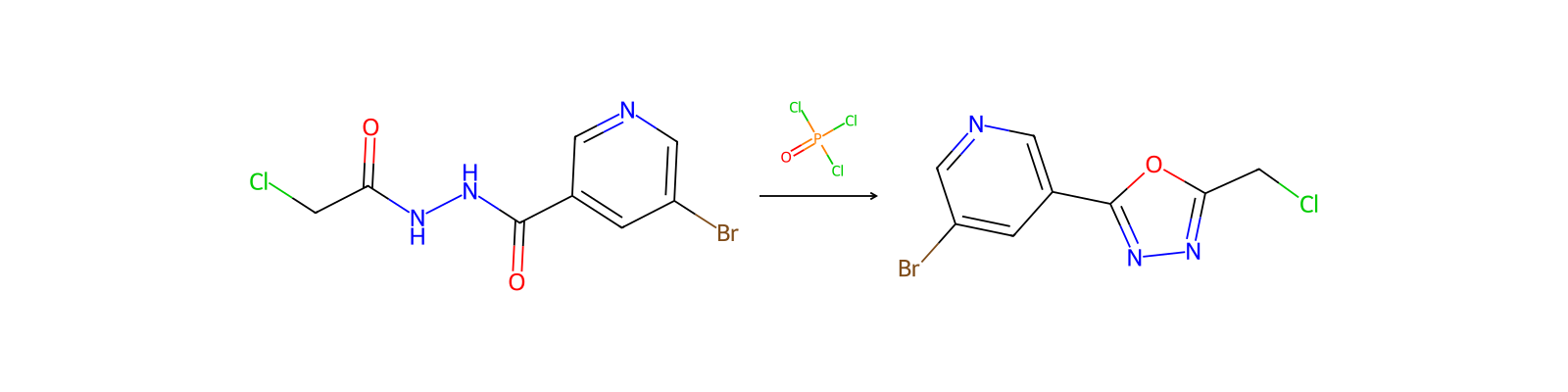
[Br:1][C:2]1[CH:3]=[C:4]([C:8]([NH:10][NH:11][C:12](=[O:15])[CH2:13][Cl:14])=O)[CH:5]=[N:6][CH:7]=1>O=P(Cl)(Cl)Cl>[Br:1][C:2]1[CH:7]=[N:6][CH:5]=[C:4]([C:8]2[O:15][C:12]([CH2:13][Cl:14])=[N:11][N:10]=2)[CH:3]=1Participants
Reactant 1

Product 1

Reagents, catalysts & solvents 1

Conditions
- Temperature
- 110 °C
Procedure
A suspension of 5-bromo-N′-(chloroacetyl)-3-pyridinecarbohydrazide (3.65 g, 12.48 mmol) in POCl3 (20 mL) was heated at 110° C. for 1.5 h. Upon cooling, the mixture was concentrated in vacuo. The residue was diluted with EtOAc and sat'd NaHCO3 solution was added slowly while stirring. The pH of the aqueous phase was adjusted to ˜8 by addition of sat'd K2CO3 solution. The phases were separated and the aqueous phase was extracted twice with EtOAc. The combined organic phases were washed with sat'd brine, dried (Na2SO4), and concentrated in vacuo. The residue was purified by flash chromatography (0-50% EtOAc-hexanes gradient) to afford the title compound as a light yellow solid (2.01 g, 59% yield): MS (ES) m/z 274 and 276 (M+1 Br isotopes).
Workup
- temperatureUpon cooling
- concentrationthe mixture was concentrated in vacuo
- additionThe residue was diluted with EtOAc
- additionwas added slowly
- additionThe pH of the aqueous phase was adjusted to ˜8 by addition of sat'd K2CO3 solution
- customThe phases were separated
- extractionthe aqueous phase was extracted twice with EtOAc
- washThe combined organic phases were washed with sat'd brine
- dry with materialdried (Na2SO4)
- concentrationconcentrated in vacuo
- customThe residue was purified by flash chromatography (0-50% EtOAc-hexanes gradient)
Sources & evidence
- ORD record
- ord-9de0d2289a2c444ba3577e8e18a6c563
- Source dataset
- uspto-grants-2011_09
- Patent number
- US08026262B2
Reaction notes
Loading…