Sodium Bicarbonate → Carbon Dioxide
Reaction equation

[C:1](=O)([OH:3])[O-:2].[Na+:5].[C:6]([CH:9]([CH:11]([C:13]([O-:15])=[O:14])[OH:12])[OH:10])([OH:8])=[O:7].[K+:16]>O>[C:6]([CH:9]([CH:11]([C:13]([O-:15])=[O:14])[OH:12])[OH:10])([O-:8])=[O:7].[Na+:5].[K+:16].[C:1](=[O:3])=[O:2]Participants
Reactant 2


Product 2

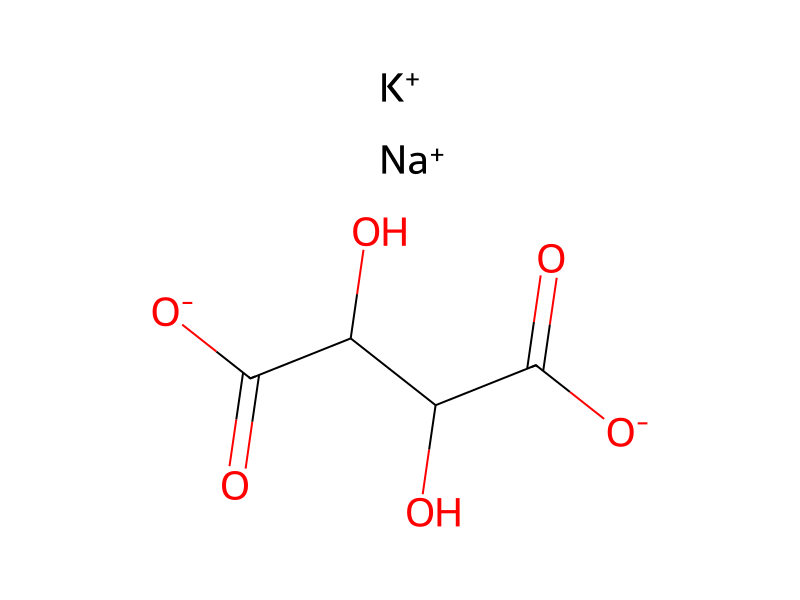
Reagents, catalysts & solvents 1

Procedure
The material selected for powder particles 16 should be inert with respect to the cellulosic material and reactive with respect to the moisture (e.g., water) to be absorbed. Preferably, the material selected for powder particles 16 should also generate water as a product of its chemical reaction with water. For example, if powder particles 16 comprise a mixture of sodium bicarbonate (NaHCO3) and citric acid (H3C6H5O7), a reaction of this mixture with water yields sodium citrate (Na3C6H5O7), carbon dioxide (CO2) and water (H2O). Another preferred example for powder particles 16 is a mixture of sodium bicarbonate (NaHCO3) and potassium hydrogen tartrate (KHC4H4O6). A reaction of this mixture with water yields potassium sodium tartrate (KNaC4H4O6), carbon dioxide and water. Note that any amount of water is sufficient to start the reaction. Once started, no additional water is needed as the reaction self-produces water.
Sources & evidence
- ORD record
- ord-5a9c361a1b7e4fcbbada3b56ac3f7c32
- Source dataset
- uspto-grants-2007_09
- Patent number
- US07266939B1
Reaction notes
Loading…