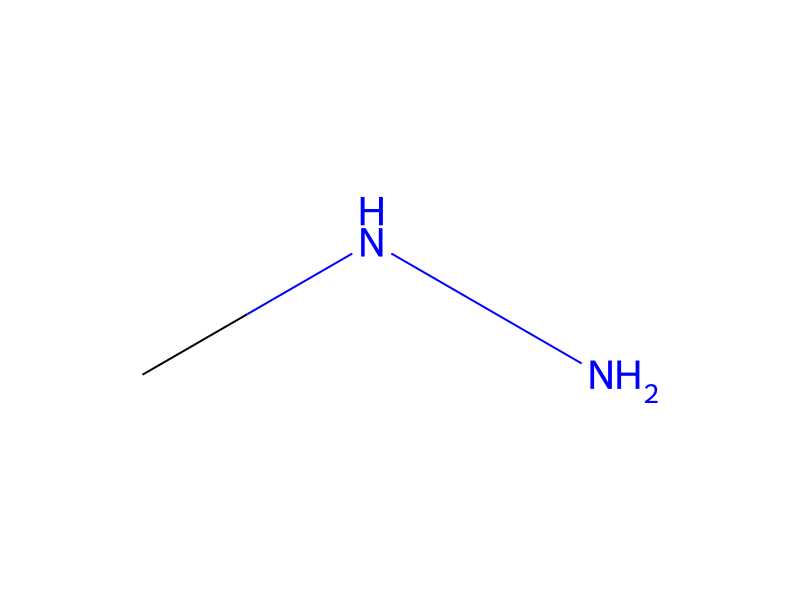
Methylhydrazine → HCID 12143941, compound
Reaction equation

C[O:2][C:3]([C:5]1[CH2:10][CH2:9][CH2:8][N:7]([C:11]2[C:16]([CH3:17])=[CH:15][C:14]([CH3:18])=[CH:13][C:12]=2[Cl:19])[C:6]=1SC)=O.[CH3:22][NH:23][NH2:24].O.C1(C)C=CC(S(O)(=O)=O)=CC=1>CO>[Cl:19][C:12]1[CH:13]=[C:14]([CH3:18])[CH:15]=[C:16]([CH3:17])[C:11]=1[N:7]1[CH2:8][CH2:9][CH2:10][C:5]2[C:3](=[O:2])[N:23]([CH3:22])[NH:24][C:6]1=2Participants
5
Reactant 3


Product 1

Reagents, catalysts & solvents 1

Conditions
- Temperature
- 130 °C
Procedure
1-(2-Chloro-4,6-dimethyl phenyl)-2-methylsulfanyl-1,4,5,6-tetrahydropyridine-3-carboxylic acid methyl ester (4.99 g), methylhydrazine (16.4 mL), p-toluenesulfonic acid monohydrate (2.91 g), and methanol (75 mL) were combined in a glass vessel sealed with a Telfon™ screw cap. The reaction mixture was stirred in a 130° C. oil bath for 24 h, then cooled to room temperature and concentrated on the rotary evaporator. The residue was chromatographed on silica gel using a methanol/dichloromethane gradient to give 3.21 g of 7-(2-chloro-4,6-dimethylphenyl)-2-methyl-1,2,4,5,6,7-hexahydropyrazolo-[3,4-b]pyridin-3-one, mp 95.9-99.9° C.
Workup
- customsealed with a Telfon™
- customscrew cap
- temperaturecooled to room temperature
- concentrationconcentrated on the rotary evaporator
- customThe residue was chromatographed on silica gel using a methanol/dichloromethane gradient
Sources & evidence
- ORD record
- ord-6781c0fdaa7a4f8c90d680615fd50e8e
- Source dataset
- uspto-grants-2007_09
- Patent number
- US07268146B2
Reaction notes
Loading…