Dicyclohexylcarbodiimide → 2,5-Dioxopyrrolidin-1-yl 4-bromobenzoate
Reaction equation

[Br:1][C:2]1[CH:10]=[CH:9][C:5]([C:6]([OH:8])=[O:7])=[CH:4][CH:3]=1.O[N:12]1[C:16](=[O:17])[CH2:15][CH2:14][C:13]1=[O:18].C1(N=C=NC2CCCCC2)CCCCC1>O1CCOCC1>[C:13]1(=[O:18])[N:12]([O:7][C:6](=[O:8])[C:5]2[CH:9]=[CH:10][C:2]([Br:1])=[CH:3][CH:4]=2)[C:16](=[O:17])[CH2:15][CH2:14]1Participants
5
Reactant 3

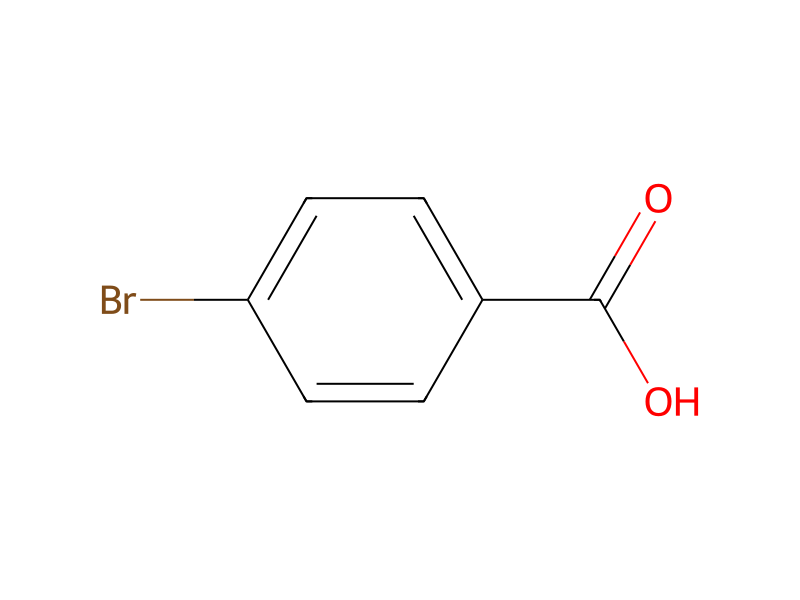

Product 1

Reagents, catalysts & solvents 1

Conditions
- Temperature
- 23 °C
Procedure
To 4-bromobenzoic acid (5.00 g, 24.9 mmol, 1.00 equiv) and N-hydroxysuccinimide (3.66 g, 31.8 mmol, 1.28 equiv) in a round-bottom flask in dioxane (120 mL) was added an dioxane solution (30 mL) that contained 1,3-dicyclohexylcarbodiimide (DCC) (6.77 g, 32.8 mmol, 1.32 equiv) dropwise over 5 min at 23 ° C. The reaction mixture was stirring at 23 ° C. for 24 h. The reaction mixture was concentrated in vacuo and the crude product was obtained by recrystallization in a cold acetone. The crude product was further purified by chromatography on silica gel eluting with hexanes/EtOAc 2:1 (v/v) to afford 6.34 g of the title compound as a colorless solid (86%).
Workup
- customdropwise over 5 min
- customat 23 ° C
- concentrationThe reaction mixture was concentrated in vacuo
- customthe crude product was obtained by recrystallization in a cold acetone
- customThe crude product was further purified by chromatography on silica gel eluting with hexanes/EtOAc 2:1 (v/v)
Sources & evidence
- ORD record
- ord-dac5805c0e59419ab9309158d595689c
- Source dataset
- uspto-grants-2016_03
- Patent number
- US09273083B2
Reaction notes
Loading…