Hydroquinone → 2,6,6-Trimethyl-3,3-bis(2,6,6-trimethyl-3-bicyclo[3.1.1]hept-1-enyl)bicyclo[3.1.1]hept-1-ene
Reaction equation

[C:1]12[CH2:9][CH:5]([C:6]1([CH3:8])[CH3:7])[CH2:4][C:3](C1=CC(OC1=O)=O)([C:10]1([CH:20]3[CH2:25][CH:24]4[CH2:26][C:22]([C:23]4([CH3:28])[CH3:27])=[C:21]3[CH3:29])[CH2:15][CH:14]3[CH2:16][C:12]([C:13]3([CH3:18])[CH3:17])=[C:11]1[CH3:19])[C:2]=2[CH3:37].C1C=CC(/C=C/CO[C@@H]2O[C@H](CO)[C@@H](O)[C@H](O)[C@H]2O)=CC=1.CCCCCCCCCC/C=C/C1C(=O)OC(=O)C1.C1(C=CC(O)=CC=1)O>CO>[C:1]12[CH2:9][CH:5]([C:6]1([CH3:8])[CH3:7])[CH2:4][CH:3]([C:10]1([CH:20]3[CH2:25][CH:24]4[CH2:26][C:22]([C:23]4([CH3:28])[CH3:27])=[C:21]3[CH3:29])[CH2:15][CH:14]3[CH2:16][C:12]([C:13]3([CH3:17])[CH3:18])=[C:11]1[CH3:19])[C:2]=2[CH3:37]Participants
Reactant 5
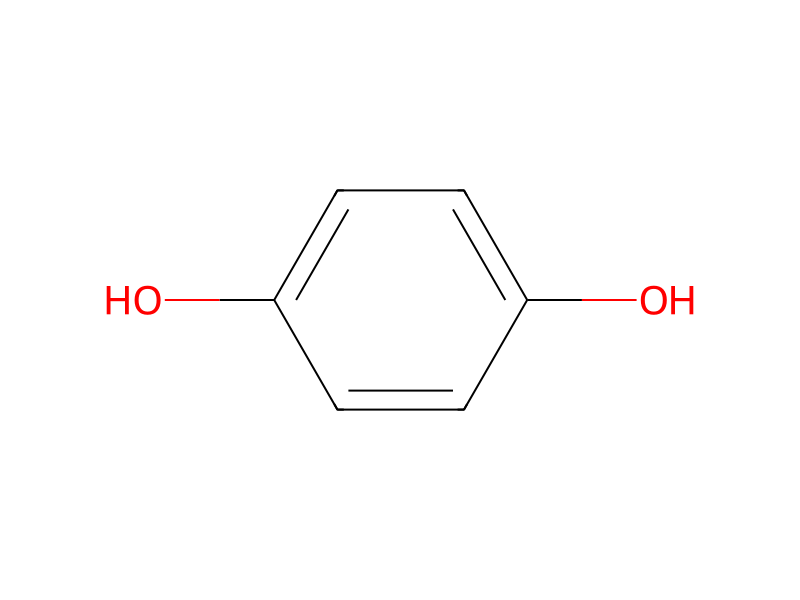


Product 1

Reagents, catalysts & solvents 1
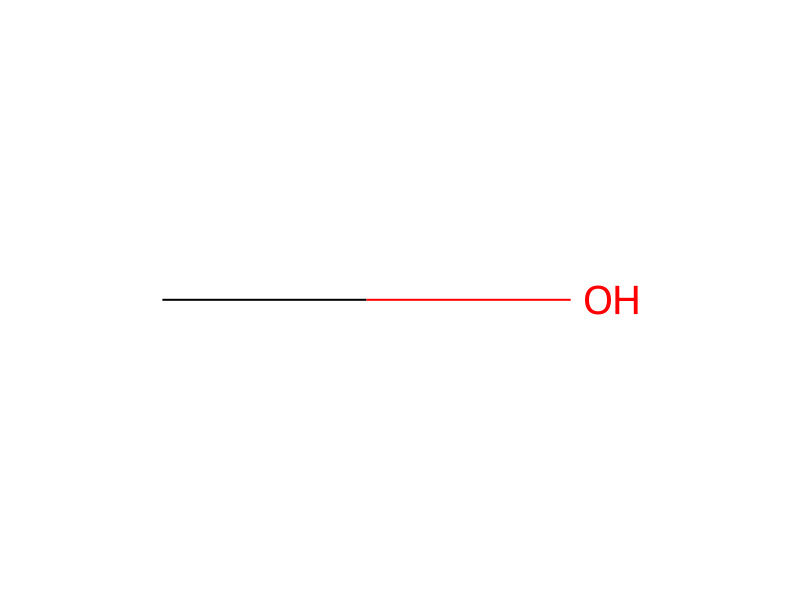
Conditions
- Temperature
- 170 °C
Procedure
A 1 liter Parr reactor equipped with a mechanical stirrer, bottom drain valve and distillation apparatus, was charged with NDC (111.0 g, 0.453 moles, 0.121 eq), PPG (211.0 g, 2.768 moles, 0.508 eq; excess 0.232 eq), terpinene-maleic anhydride adduct (42 g, 0.180 moles, 0.048 eq), Rosin-Ar (88 g, 0.249 moles, 0.0667 eq), DDSA (118 g, 0.445 moles, 0.119 eq), SA (53.0 g, 0.453 moles, 0.121 eq) followed by 1.0 g of both Fascat 4100 and Vertec AC422 titanium catalyst. About 0.4 g of hydroquinone were added as a free radical scavenger to prevent crosslinking of resin. The reactor was blanketed with nitrogen and the temperature of the reactor was slowly raised to 170° C. with stirring (once the solids melted). The reaction mixture was maintained for 15 hours under nitrogen at 205° C. while methanol was continuously collected in a collection flask. The reaction mixture was heated to 215° C. and low vacuum was applied. A higher vacuum (<0.1 Torr) was applied. During that time, propylene glycol distilled off and when the softening point of the resin reached 97.8° C., the reactor temperature was reduced to 180° C. and the second portion of terpinene-maleic anhydride (14 g, 0.058 moles, 0.0154 eq) was added. The reaction mixture temperature was slowly raised to 225° C. while under high vacuum for another 10 hours until a softening point of 103.5° C. was achieved. The temperature was then lowered to 190° C. and the polymer was discharged onto a polytetrafluoroethylene (Teflon) pan.
Workup
- customA 1 liter Parr reactor equipped with a mechanical stirrer, bottom drain valve
- distillationdistillation apparatus
- customwas continuously collected in a collection flask
- temperatureThe reaction mixture was heated to 215° C.
- distillationDuring that time, propylene glycol distilled off
- customreached 97.8° C.
- customwas reduced to 180° C.
- temperatureThe reaction mixture temperature was slowly raised to 225° C. while under high vacuum for another 10 hours until a softening point of 103.5° C.
- customwas then lowered to 190° C.
Sources & evidence
- ORD record
- ord-236ed4b04971452ab60d1fd58087f68b
- Source dataset
- uspto-grants-2016_03
- Patent number
- US09273178B2
Reaction notes
Loading…