Morpholine → 2-ethylsulfanyl-N-[(3-fluorophenyl)-methyl]-4-methyl-6-morpholin-4-yl-pyridine-3-carboxylic acid amide
Reaction equation
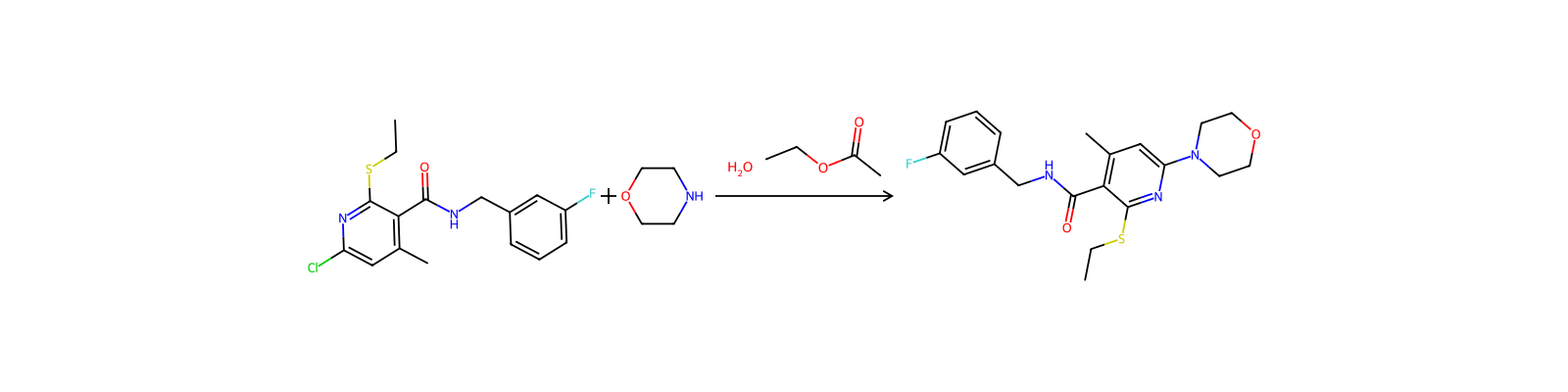
Cl[C:2]1[N:7]=[C:6]([S:8][CH2:9][CH3:10])[C:5]([C:11]([NH:13][CH2:14][C:15]2[CH:20]=[CH:19][CH:18]=[C:17]([F:21])[CH:16]=2)=[O:12])=[C:4]([CH3:22])[CH:3]=1.[NH:23]1[CH2:28][CH2:27][O:26][CH2:25][CH2:24]1>O.CCOC(C)=O>[CH2:9]([S:8][C:6]1[C:5]([C:11]([NH:13][CH2:14][C:15]2[CH:20]=[CH:19][CH:18]=[C:17]([F:21])[CH:16]=2)=[O:12])=[C:4]([CH3:22])[CH:3]=[C:2]([N:23]2[CH2:28][CH2:27][O:26][CH2:25][CH2:24]2)[N:7]=1)[CH3:10]Participants
5
Reactant 2


Product 1

Reagents, catalysts & solvents 2


Conditions
- Temperature
- 120 °C
Procedure
A mixture of 1.5 g (4.4 mmol) 6-chloro-2-ethylsulfanyl-N-[(3-fluorophenyl)-methyl]-4-methyl-pyridine-3-carboxylic acid amide and 1.9 ml (22.1 mmol) morpholine was heated in the microwave at 120° C. for 30 min. Subsequently the RM was diluted with water and EtOAc and the layers were separated. The organic layer was washed with a 1M aq. NaOH sol. and brine, dried over MgSO4 and concentrated in vacuo. Crystallisation (hexane/EtOAc 3:1) of the residue yielded 1.3 g (3.3 mmol, 75%) 2-ethylsulfanyl-N-[(3-fluorophenyl)-methyl]-4-methyl-6-morpholin-4-yl-pyridine-3-carboxylic acid amide (example 2). [M+H]+ 390.2.
Workup
- customthe layers were separated
- washThe organic layer was washed with a 1M aq. NaOH sol. and brine
- dry with materialdried over MgSO4
- concentrationconcentrated in vacuo
- customCrystallisation (hexane/EtOAc 3:1) of the residue
Sources & evidence
- ORD record
- ord-4bc20604dcfd4863aa5fffec3c47f37a
- Source dataset
- uspto-grants-2016_03
- Patent number
- US09278103B2
Reaction notes
Loading…