1,3-Propanediol → HCID 86719339, compound
Reaction equation

[Br:1][C:2]1[CH:3]=[C:4]([CH:7]=[C:8]([O:10][CH3:11])[CH:9]=1)[CH:5]=[O:6].[CH2:12](O)[CH2:13][CH2:14][OH:15]>C1(C)C=CC=CC=1.O.C1(C)C=CC(S(O)(=O)=O)=CC=1>[Br:1][C:2]1[CH:3]=[C:4]([CH:5]2[O:15][CH2:14][CH2:13][CH2:12][O:6]2)[CH:7]=[C:8]([O:10][CH3:11])[CH:9]=1Participants
5
Reactant 2
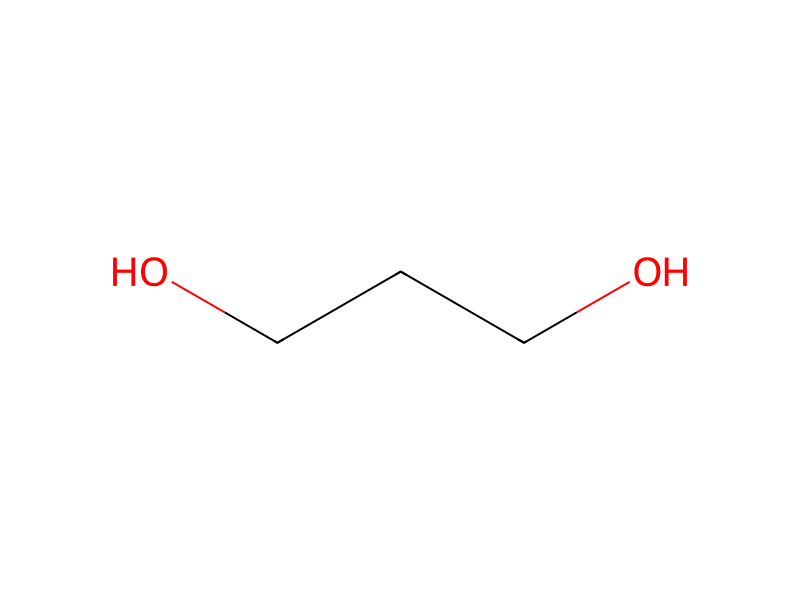

Product 1

Reagents, catalysts & solvents 2


Procedure
A solution of 3-bromo-5-methoxybenzaldehyde (3.93 g, 18.2 mmol), propane-1,3-diol (1.6 mL, 21.8 mmol) and p-toluenesulfonic acid monohydrate (0.104 g, 0.54 mmol) in anhydrous toluene (100 mL) was brought to reflux for 18 h under nitrogen. During this time water was removed using a Dean-Stark apparatus. After this time the reaction was cooled to rt, washed with 5% aqueous Na2CO3 solution (50 mL) and dried over anhydrous Na2SO4. The reaction was concentrated under reduced pressure to give 2-(3-bromo-5-methoxyphenyl)-1,3-dioxane (4.80 g, 96%) as a brown oil.
Workup
- temperatureto reflux for 18 h under nitrogen
- customDuring this time water was removed
- washwashed with 5% aqueous Na2CO3 solution (50 mL)
- dry with materialdried over anhydrous Na2SO4
- concentrationThe reaction was concentrated under reduced pressure
Sources & evidence
- ORD record
- ord-9041280c17b54d99a73b5c90506b0ff2
- Source dataset
- uspto-grants-2016_03
- Patent number
- US09278940B2
Reaction notes
Loading…