Ammonium Chloride → 4-(4,4,5,5-Tetramethyl-1,3,2-dioxaborolan-2-yl)-1H-pyrazole
Reaction equation

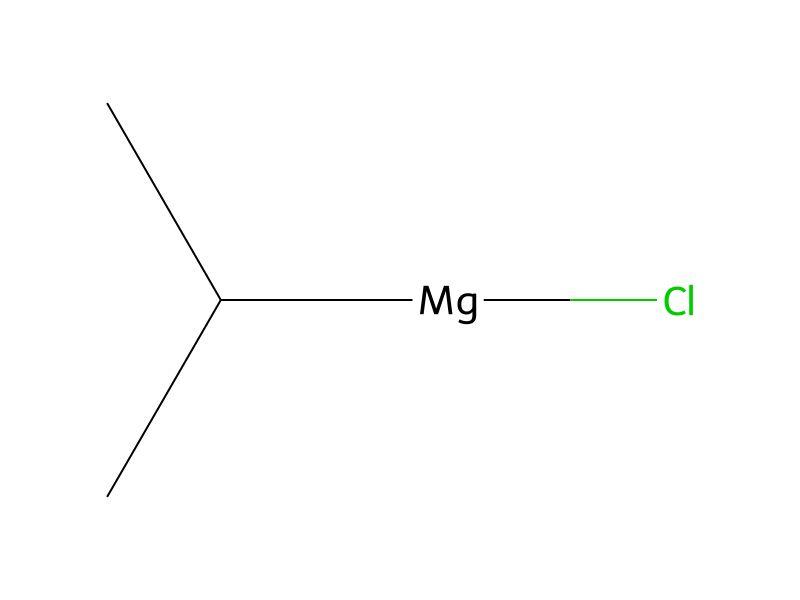
C[Si](C)(C)[N:3]1[CH:7]=[C:6](I)[CH:5]=[N:4]1.C([Mg]Cl)(C)C.C(O[B:20]1[O:24][C:23]([CH3:26])([CH3:25])[C:22]([CH3:28])([CH3:27])[O:21]1)(C)C.[Cl-].[NH4+]>[Cl-].[Na+].O.C1(C)C=CC=CC=1.C1COCC1>[CH3:27][C:22]1([CH3:28])[C:23]([CH3:26])([CH3:25])[O:24][B:20]([C:6]2[CH:5]=[N:4][NH:3][CH:7]=2)[O:21]1Participants
Reactant 4



Product 1

Reagents, catalysts & solvents 3



Conditions
- Temperature
- 0 °C
Procedure
A flask equipped with a mechanical stirrer, nitrogen inlet, addition funnel and thermowell was charged with 1-trimethylsilyl-4-iodopyrazole (15, 225.1 g, 0.85 mol) and THF (2200 mL). This mixture was cooled to −6° C. in an ice/salt/brine bath and isopropyl magnesium chloride (2 M in THF, 510 ml, 1.02 mol, 1.2 equiv) was added at a rate such that the temperature did not exceed 0° C. The extent of metal/halogen exchange was monitored by GC and was found complete after about 10 min. To the orange brown solution was added 2-isopropoxy-4,4,5,5-tetramethyl-1,3,2-dioxaborolane (isopropylpinacolborate, 16, 347 mL, 1.7 mol, 2.0 equiv) slowly at first keeping the temperature below 0° C. and then fairly rapidly after about ½ of the compound was added allowing the temperature to reach 5° C. (the reaction becomes quite thick and then thins out slowly). The reaction is then stirred at 0° C. for 10 min before being warmed to room temperature over 1 hr and stirred at room temperature for an additional 1 hr. The reaction was cooled to 6° C. and saturated aqueous ammonium chloride solution (2.2 L) was added with a temperature increase to 25° C. The mixture was stirred for 5 minutes before being diluted with toluene (10 L). The layers were separated (a large amount of solid is present in the aqueous layer) and the organic layer was sequentially washed with water (6×2.2 L), brine (2×2.2 L), dried over sodium sulfate, filtered, and concentrated under reduced pressure. Residual toluene was co-evaporated with heptane to afford 4-(4,4,5,5-tetramethyl-1,3,2-dioxaborolan-2-yl)-1H-pyrazole (17, 90.3 g, 164.9 g theoretical, 54.8%) as a white solid. For 17: 1H NMR (DMSO-d6, 400 MHz) δ ppm 13.08 (bs, 1H), 7.94 (s, 1H), 7.62 (s, 1H), 1.23 (s, 12H); C9H15BN2O2 (MW, 194.04), LCMS (EI) m/e 195 (M++H).
Workup
- customA flask equipped with a mechanical stirrer, nitrogen inlet, addition funnel
- additionwas added at a rate such that the temperature
- customdid not exceed 0° C
- customthe temperature below 0° C.
- additionfairly rapidly after about ½ of the compound was added
- customto reach 5° C.
- temperaturebefore being warmed to room temperature over 1 hr
- stirringstirred at room temperature for an additional 1 hr
- temperatureThe reaction was cooled to 6° C.
- temperatureincrease to 25° C
- stirringThe mixture was stirred for 5 minutes
- customThe layers were separated (a large amount of solid
- washwas sequentially washed with water (6×2.2 L), brine (2×2.2 L)
- dry with materialdried over sodium sulfate
- filtrationfiltered
- concentrationconcentrated under reduced pressure
Sources & evidence
- ORD record
- ord-f64e05e0b9784c7a934786fe44d1645b
- Source dataset
- uspto-grants-2016_03
- Patent number
- US09290506B2
Reaction notes
Loading…