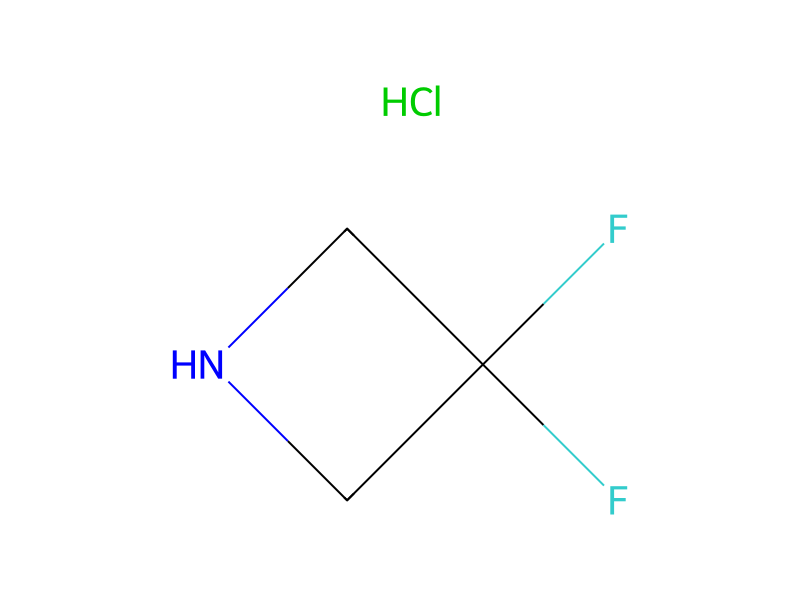
Diisopropylethylamine → HCID 86721072, compound
Reaction equation

Cl.[F:2][C:3]1([F:7])[CH2:6][NH:5][CH2:4]1.C(N(C(C)C)C(C)C)C.[Br:17][C:18]1[CH:19]=[C:20]([S:25](Cl)(=[O:27])=[O:26])[CH:21]=[CH:22][C:23]=1[F:24]>ClCCl>[Br:17][C:18]1[CH:19]=[C:20]([S:25]([N:5]2[CH2:6][C:3]([F:7])([F:2])[CH2:4]2)(=[O:26])=[O:27])[CH:21]=[CH:22][C:23]=1[F:24]Participants
5




Procedure
To a suspension of 3,3-difluoroazetidine hydrochloric acid (0.947 g, 7.31 mmol) in 20 mL dichloromethane at 0° C. was added N-ethyl-N-isopropylpropan-2-amine (2.80 mL, 16.1 mmol) followed by the addition of a solution of 3-bromo-4-fluorobenzene-1-sulfonyl chloride (2.0 g, 7.3 mmol) in 4 mL dichloromethane. The mixture was stirred at room temperature overnight and then heated at 55° C. for 5 hours, diluted with dichloromethane, washed with water, dried over anhydrous magnesium sulfate, and filtered. The filtrate was concentrated and the residue was purified by flash chromatography (silica gel, 10-50% ethyl acetate/heptanes gradient) to give the title compound (1.5 g, 62.1% yield)
Workup
- temperatureheated at 55° C. for 5 hours
- washwashed with water
- dry with materialdried over anhydrous magnesium sulfate
- filtrationfiltered
- concentrationThe filtrate was concentrated
- customthe residue was purified by flash chromatography (silica gel, 10-50% ethyl acetate/heptanes gradient)
Sources & evidence
- ORD record
- ord-feade8799ed647a2b9edb11254f71dc9
- Source dataset
- uspto-grants-2016_03
- Patent number
- US09296741B2
Reaction notes
Loading…