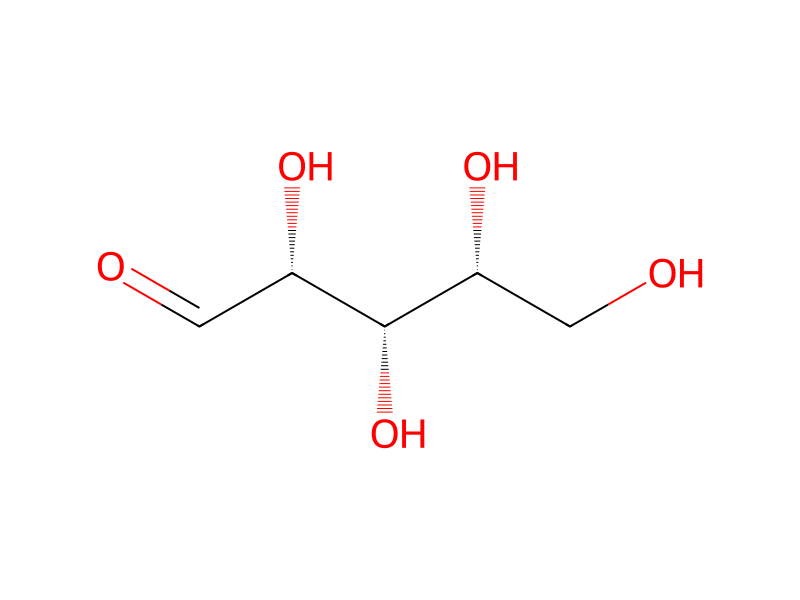
aldehydo-D-Xylose → aldehydo-D-Xylose
Reaction equation

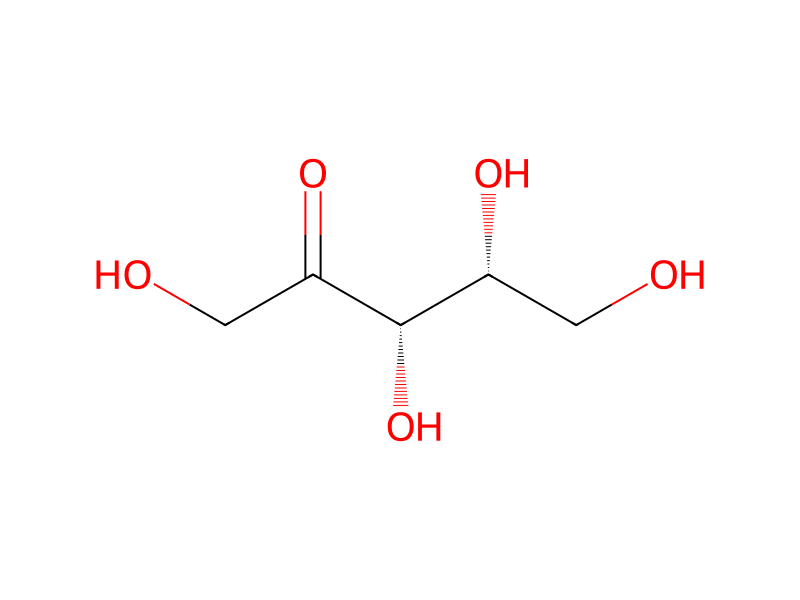
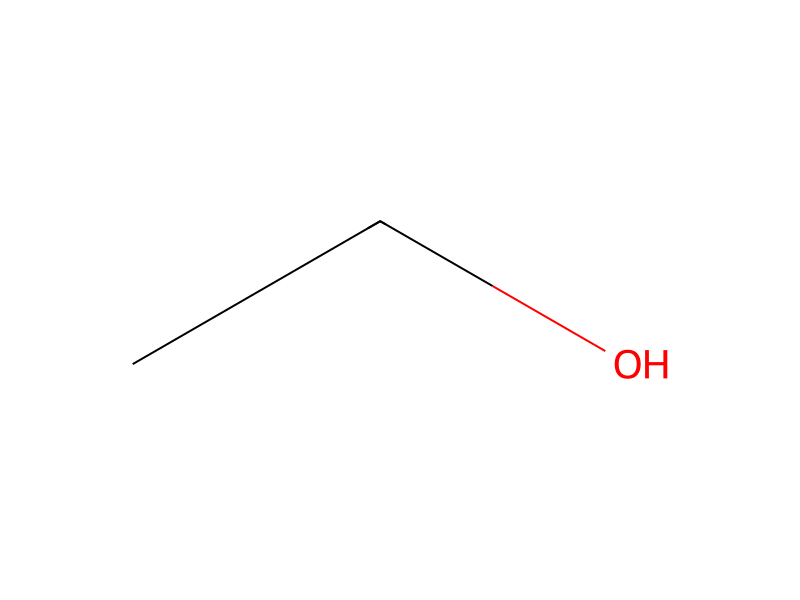
[O:1]=[CH:2][C@@H:3]([C@H:5]([C@@H:7]([CH2:9][OH:10])[OH:8])[OH:6])[OH:4]>C(O)C>[O:1]=[CH:2][C@@H:3]([C@H:5]([C@@H:7]([CH2:9][OH:10])[OH:8])[OH:6])[OH:4].[OH:1][CH2:2][C:3]([C@H:5]([C@@H:7]([CH2:9][OH:10])[OH:8])[OH:6])=[O:4]Participants
Reagents, catalysts & solvents 1
Procedure
Pichia stipitis is known to ferment D-xylose to ethanol more efficiently than other native yeasts previously described (Prior, et al., Process Biochemistry 24(1), 21-32 (1989)). The Pichia stipitis that had been deposited at the USDA's ARS Culture Collection (deposit accession number NRRL Y-7124) was recently renamed Scheffersomyces stipitis (Kurtzman and Suzuki, Mycoscience 5(2), 2-14 (2010)) and is particularly useful because it has strong NADH-linked, as opposed to NADPH-linked, aldose reductase activity providing for a more favorable cofactor balance in the conversion of xylose to xylulose (Bruinenberg, et al., Applied Micro. and Biotech. 19, 256-260 (1984)). S. stipitis strain NRRL Y-7124 ferments hexoses and xylose to economically recoverable concentrations of ethanol exceeding 40 g/L with almost no accumulation of xylitol byproduct (Slininger, et al., Biotechnology Letters 7, 431-436 (1985); Slininger, et al., Biotechnology and Bioengineering 35, 727-731 (1990a); Slininger, et al., Annals of the New York Academy of Science 589, 25-40 (1990b)). In nutritionally optimized media, this S. stipitis strain is able to produce over 70 g/L ethanol in 40 hours (1.75 g/L/h) from 150 g/L sugars at a yield of 0.41±0.06 g/g and an ethanol productivity of 1.6 g/L/h in high density fermentations (6 g/L cells) (Slininger, et al. (1985); Slininger, et al., Applied Microbiology and Biotechnology 72, 1285-1296 (2006); Slininger, et al., Biotechnology and Bioengineering 108(8), 1801-1815 (2011)). Given appropriate nitrogen levels, it is also relatively resistant to fermentation inhibitors ethanol, furfural, and hydroxymethylfurfural (HMF) (Slininger, et al., Biotechnology and Bioengineering 102(3):778-790 (2009)). Scheffersomyces stipitis is one of the most viable native pentose-fermenting yeasts available for commercial scale-up, as reviewed by Agbogbo and Coward-Kelly (Biotechnology Letters 30, 1515-1524 (2008)) who point to the need to improve sugar uptake rate in biomass hydrolyzates, including reducing the effects of diauxy and improving ethanol and inhibitor tolerance. Thus, there is a need for novel strains of S. stipitis which are tolerant of diverse lignocellulosic hydrolyzates.
Workup
- customThe Pichia stipitis that had been deposited at the USDA's ARS Culture Collection (deposit accession number NRRL Y-7124)
Sources & evidence
- ORD record
- ord-d846779fa7c24e6f9687c294b84cab6a
- Source dataset
- uspto-grants-2016_03
- Patent number
- US09297027B1
Reaction notes
Loading…