Water → HCID 10538577, compound
Reaction equation

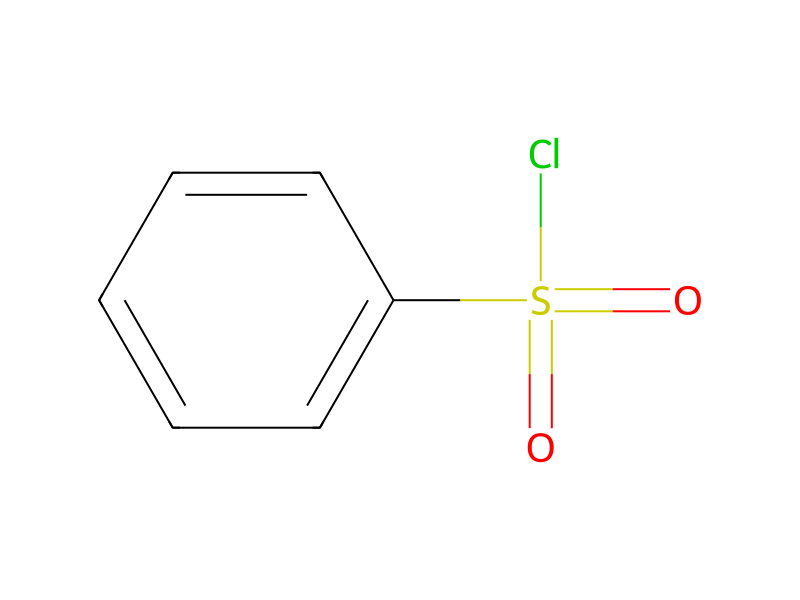
[C:1]1([S:7](Cl)(=[O:9])=[O:8])[CH:6]=[CH:5][CH:4]=[CH:3][CH:2]=1.[OH:11][C:12]1[CH:13]=[CH:14][C:15]([CH3:18])=[N:16][CH:17]=1.C(N(CC)CC)C.O>ClCCl>[C:1]1([S:7]([O:11][C:12]2[CH:13]=[CH:14][C:15]([CH3:18])=[N:16][CH:17]=2)(=[O:9])=[O:8])[CH:6]=[CH:5][CH:4]=[CH:3][CH:2]=1Participants
Reactant 4



Product 1

Reagents, catalysts & solvents 1

Conditions
- Temperature
- 0 °C
Procedure
Benzenesulfonyl chloride (12.9 mL, 101 mmol, 1.10 equiv) was added to a stirred solution of 5-hydroxy-2-methylpyridine (10.0 g, 91.6 mmol, 1 equiv) and triethylamine (15.3 mL, 110 mmol, 1.20 equiv) in dichloromethane (100 mL) at 0° C. After stirring for 2 h at 0° C., water (20 mL) was added and the resulting two-phase mixture was stirred vigorously for 1 h at 23° C. to quench any remaining sulfonyl chloride. Saturated aqueous potassium carbonate solution (100 mL) was added and the layers were separated. The aqueous layer was extracted with a second portion of dichloromethane (150 mL). The combined organic layers were dried over anhydrous potassium carbonate, filtered and concentrated in vacuo. The residue was purified by chromatography on silica gel eluting with a gradient of 4:1 to 1:1 of hexane and ethyl acetate to provide 4 (21.8 g, 95%) as an oil. Chromatography may be avoided by using exactly one equivalent of benzenesulfonyl chloride to afford product of sufficient purity for direct submission to benzylic bromination conditions (see below). IR (neat) 3066, 1594, 1480, 1450, 1384, 1286, 1204, 1177, 1093, 1024, 865, 837, 804, 757, 741, 724, 692; 1H NMR (CDCl3) 8.01(d, 1H, J=2.7), 7.84 (d, 2H, J=7.9), 7.70 (t, 1H, J=7.2), 7.55 (t, 2H, J=7.8), 7.33 (dd, 1H, J=8.5, 2.7), 7.13 (d, 1H, J=8.5), 2.53 (s, 3H). Anal. Calcd. for C12H11NO3S: C, 57.82; H, 4.45; N, 5.62. Found C, 57.66; H, 4.33; N, 5.47.
Workup
- stirringthe resulting two-phase mixture was stirred vigorously for 1 h at 23° C.
- customto quench any remaining sulfonyl chloride
- additionSaturated aqueous potassium carbonate solution (100 mL) was added
- customthe layers were separated
- extractionThe aqueous layer was extracted with a second portion of dichloromethane (150 mL)
- dry with materialThe combined organic layers were dried over anhydrous potassium carbonate
- filtrationfiltered
- concentrationconcentrated in vacuo
- customThe residue was purified by chromatography on silica gel eluting with a gradient of 4:1 to 1:1 of hexane and ethyl acetate
Sources & evidence
- ORD record
- ord-abd7c44f57384e80ac11c1d918ef85d0
- Source dataset
- uspto-grants-1998_06
- Patent number
- US05760237
Reaction notes
Loading…