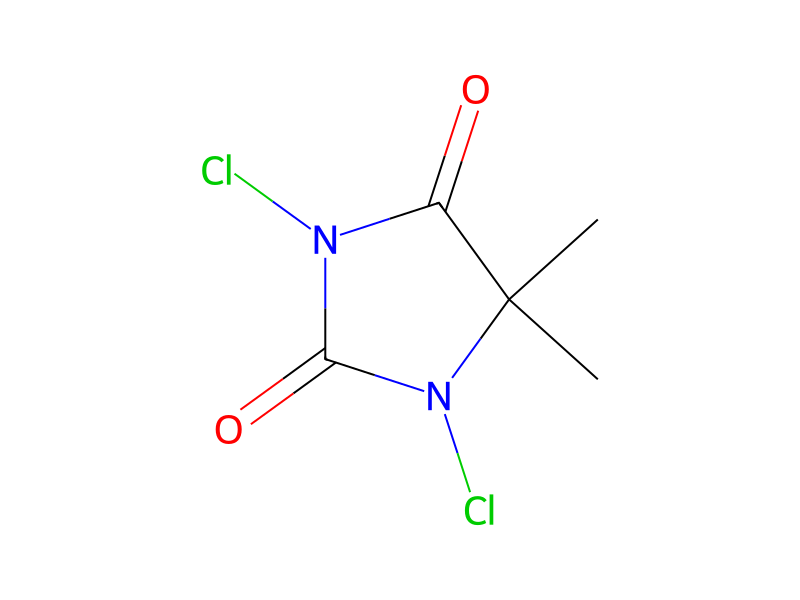
1,3-Dichloro-5,5-dimethylhydantoin → 8-Amino-2-benzylthio-5-chloro[1,2,4]triazolo[1,5-a]pyridine
Reaction equation

[NH2:1][C:2]1[C:3]2[N:4]([N:8]=[C:9]([S:11][CH2:12][C:13]3[CH:18]=[CH:17][CH:16]=[CH:15][CH:14]=3)[N:10]=2)[CH:5]=[CH:6][CH:7]=1.[Cl:19]N1C(C)(C)C(=O)N(Cl)C1=O.S(=O)(O)[O-].[Na+]>ClCCl>[NH2:1][C:2]1[C:3]2[N:4]([N:8]=[C:9]([S:11][CH2:12][C:13]3[CH:14]=[CH:15][CH:16]=[CH:17][CH:18]=3)[N:10]=2)[C:5]([Cl:19])=[CH:6][CH:7]=1Participants




Procedure
A solution of 8-amino-2-benzylthio[1,2,4]triazolo[1,5-a]pyridine (14.0 g, 0.0546 mol) and 1,3-dichloro-5,5-dimethylhydantoin (5.4 g, 0.0273 mol) were combined in 500 mL of dichloromethane and the mixture was heated at reflux with stirring for two hours. Additional 1,3-dichloro-5,5-dimethylhydantoin (5.0 g, 0.025 mol) was added and the reaction was heated with stirring for an additional hour. The reaction mixture was cooled and dilute aqueous sodium bisulfite was added with stirring and allowed to react for an hour. The mixture was then washed with water and the volatiles were removed by evaporation under reduced pressure. The residue obtained was chromatographed on silica gel eluting with dichloromethane to obtain 6.0 g (38 percent of theory) of the title compound as a light tan powder melting at 113°-114° C.
Workup
- temperaturethe mixture was heated
- temperatureat reflux
- temperaturethe reaction was heated
- stirringwith stirring for an additional hour
- temperatureThe reaction mixture was cooled
- stirringwith stirring
- customto react for an hour
- washThe mixture was then washed with water
- customthe volatiles were removed by evaporation under reduced pressure
- customThe residue obtained
- customwas chromatographed on silica gel eluting with dichloromethane
Sources & evidence
- ORD record
- ord-fabb56535f8141c49473a540e72eff0b
- Source dataset
- uspto-grants-1998_06
- Patent number
- US05763359
Reaction notes
Loading…