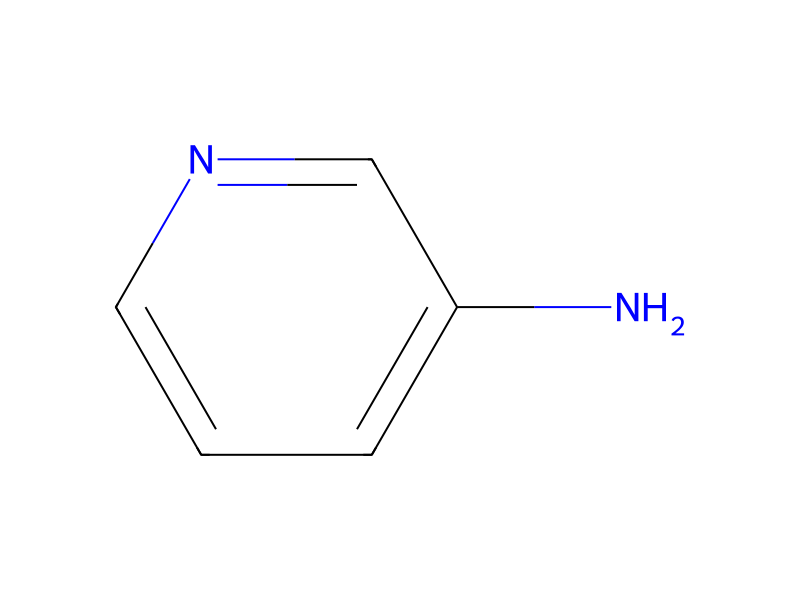
Pyridine → HCID 67646535, compound
Reaction equation

[NH2:1][C:2]1[CH:3]=[N:4][CH:5]=[CH:6][CH:7]=1.[N+:8]([C:11]1[CH:19]=[CH:18][C:14]([C:15](Cl)=[O:16])=[CH:13][CH:12]=1)([O-])=O.N1C=CC=CC=1>C(O)C>[NH2:8][C:11]1[CH:19]=[CH:18][C:14]([C:15]([N:4]2[CH:5]=[CH:6][CH:7]=[C:2]([NH2:1])[CH2:3]2)=[O:16])=[CH:13][CH:12]=1Participants
Reactant 3


Product 1

Reagents, catalysts & solvents 1

Procedure
3-Aminopyridine, 60, is first reacted with 4-nitrobenzoyl chloride in the presence of pyridine at 80° C. (step 1) and the product, 62, is subsequently hydrogenated in the presence of ethanol (step 2) to give N-(p-aminobezoyl) -3-aminopyridine, 64. In a separate reaction, 2,5-dimethyl-1,4-phenylenediamine, 66, is converted to 2,5-dimethyl-1,4-dinitrobenzene in a "reverse" Sandmeyer reaction with isoamyl nitrite and acetic acid (step 3), and subsequently treated with copper sulfate in the presence of sodium nitrite (step 4) to produce the intermediate, 68. This intermediate, 68, is oxidized with CrO3 and chlorinated with SOCl2 (step 5) to give 2,5-dinitroterephthaloyl chloride 70. One equivalent of N-(p-aminobezoyl)-3-aminopyridine, 64, and 0.5 equivalent of 2,5-dinitroterephthaloyl chloride, 70, are reacted in pyridine (step 6) to produce a bis-anilide derivative of 2,5-dinitroterephthaloyl chloride 72, and the product is again hydrogenated and activated with isoamyl nitrite (step 7) to yield the final activated product 74.
Sources & evidence
- ORD record
- ord-9474ba24bc59421e9e91497f7c624400
- Source dataset
- uspto-grants-1998_06
- Patent number
- US05770736
Reaction notes
Loading…