4-Toluenesulfonyl chloride → 4-Penten-2-ol p-toluenesulfonate
Reaction equation

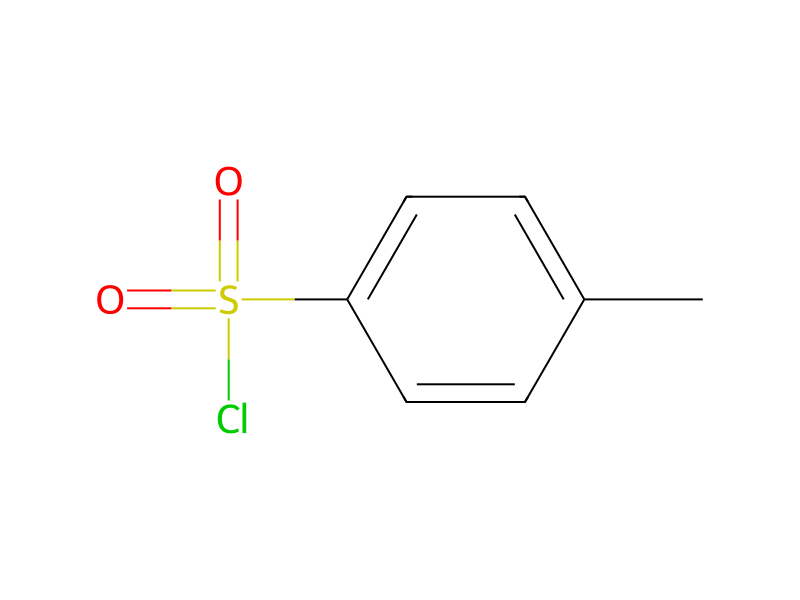
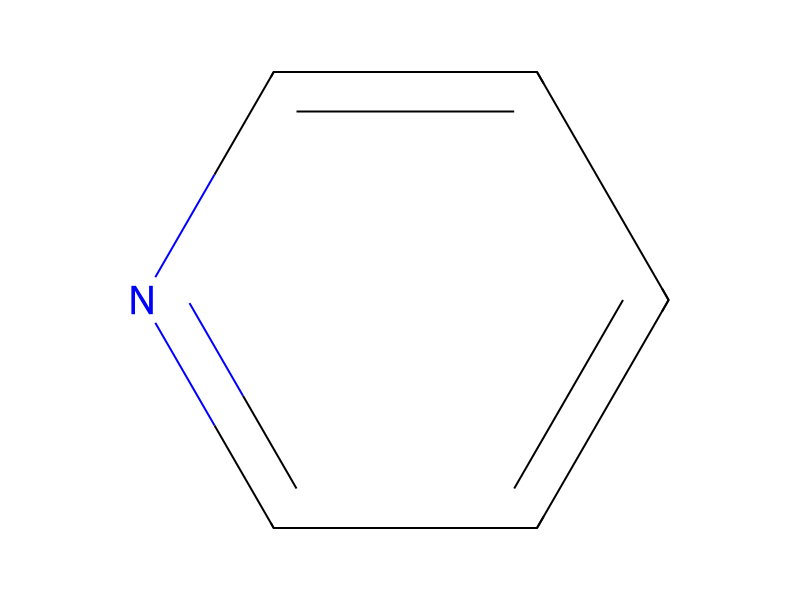
CN(C(OC(C)(C)C)=O)C(CC=C)C.Br[C:16]1[CH:17]=[C:18]([O:22]C(C)C)[CH:19]=N[CH:21]=1.BrC1C=NC=C(C=1)C(O)=O.CC(O)CC=C.[C:42]1([CH3:52])[CH:47]=[CH:46][C:45]([S:48](Cl)(=[O:50])=[O:49])=[CH:44][CH:43]=1>N1C=CC=CC=1>[C:42]1([CH3:52])[CH:47]=[CH:46][C:45]([S:48]([O:22][CH:18]([CH2:17][CH:16]=[CH2:21])[CH3:19])(=[O:50])=[O:49])=[CH:44][CH:43]=1Participants
Reactant 5


Product 1

Reagents, catalysts & solvents 1
Procedure
The manner in which certain aryl substituted olefinic amine compounds possessing a branched side chain, such as (4E)-N-methyl-5-(5-isopropoxy-3-pyridyl)-4-penten-2-amine, are provided can vary. By using one synthetic approach, the latter compound can be synthesized in a convergent manner, in which the side chain, N-methyl-N-(tert-butoxycarbonyl)-4-penten-2-amine is coupled with the 3-substituted 5-halo-substituted pyridine, 5-bromo-3-isopropoxypyridine, under Heck reaction conditions, followed by removal of the tert-butoxycarbonyl protecting group. Typically, the types of procedures set forth in W. C. Frank et al., J. Org. Chem. 43: 2947 (1978) and N. J. Malek et al., J. Org. Chem. 47: 5395 (1982) involving a palladium-catalyzed coupling of an olefin and an aromatic halide are used. The required N-methyl-N-(tert-butoxycarbonyl)-4-penten-2-amine can be synthesized as follows: (i) commercially available 4-penten-2-ol (Aldrich Chemical Company, Lancaster Synthesis Inc.) can be treated with p-toluenesulfonyl chloride in pyridine to yield 4-penten-2-ol p-toluenesulfonate, previously described by T. Michel, et al., Liebigs Ann. 11: 1811 (1996); (ii) the resulting tosylate can be heated with 20 molar equivalents of methylamine as a 40% aqueous solution to yield N-methyl-4-penten-2-amine; and (iii) the resulting amine, such as previously mentioned by A. Viola et al., J. Chem. Soc., Chem. Commun. (21): 1429 (1984), can be allowed to react with 1.2 molar equivalents of di-tert-butyl dicarbonate in dry tetrahydrofuran to yield the side chain, N-methyl-N-(tert-butoxycarbonyl)-4-penten-2-amine. The halo-substituted pyridine, (e.g., 5-bromo-3-isopropoxypyridine) can be synthesized by two different routes. In one preparation, 3,5-dibromopyridine is heated at 140° C. for 14 hours with 2 molar equivalents of potassium isopropoxide in dry isopropanol in the presence of copper powder (5%, w/w of the 3,5-dibromopyridine) in a sealed glass tube to yield 5-bromo-3-isopropoxypyridine. A second preparation of 5-bromo-3-isopropoxypyridine from 5-bromonicotinic acid can be performed as follows: (i) 5-Bromonicotinic acid is converted to 5-bromonicotinamide by treatment with thionyl chloride, followed by reaction of the intermediate acid chloride with aqueous ammonia; (ii) the resulting 5-bromonicotinamide, previously described by C. V. Greco et al., J. Heteocyclic Chem. 7(4): 761 (1970), is subjected to Hofmann degradation by treatment with sodium hydroxide and a 70% solution of calcium hypochlorite; and (iii) the resulting 3-amino-5-bromopyridine, previously described by C. V. Greco et al., J. Heteocyclic Chem. 7(4): 761 (1970), can be converted to 5-bromo-3-isopropoxypyridine by diazotization with isoamyl nitrite under acidic conditions, followed by treatment of the intermediate diazonium salt with isopropanol to yield 5-bromo-3-isopropoxypyridine. The palladium-catalyzed coupling of 5-bromo-3-isopropoxypyridine and N-methyl-N-(tert-butoxycarbonyl)-4-penten-2-amine is carried out in acetonitrile-triethylamine (2:1, v,v) using a catalyst consisting of 1 mole % palladium(II) acetate and 4 mole % tri-o-tolylphosphine. The reaction can be carried out by heating the components at 80° C. for 20 hours to yield (4E)-N-methyl-N-(tert-butoxycarbonyl)-5-(5-isopropoxy-3-pyridyl)-4-penten-2-amine. Removal of the tert-butoxycarbonyl protecting group can be accomplished by treatment with 30 molar equivalents of trifluoroacetic acid in anisole at 0° C. to afford (4E)-N-methyl-5-(5-isopropoxy-3-pyridyl)-4-penten-2-amine.
Workup
- customfollowed by removal of the tert-butoxycarbonyl protecting group
- customThe required N-methyl-N-(tert-butoxycarbonyl)-4-penten-2-amine can be synthesized
Sources & evidence
- ORD record
- ord-056d08d4ba5440c08c8e684476519c37
- Source dataset
- uspto-grants-2005_10
- Patent number
- US06958399B2
Reaction notes
Loading…