Sulfuric Acid → 1,3-Propanediol bis(mercaptophenylacetate)
Reaction equation

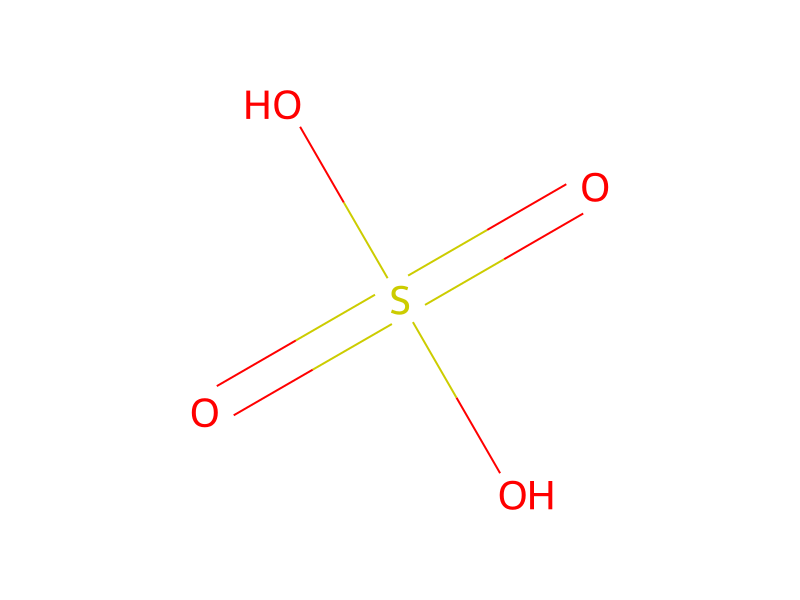
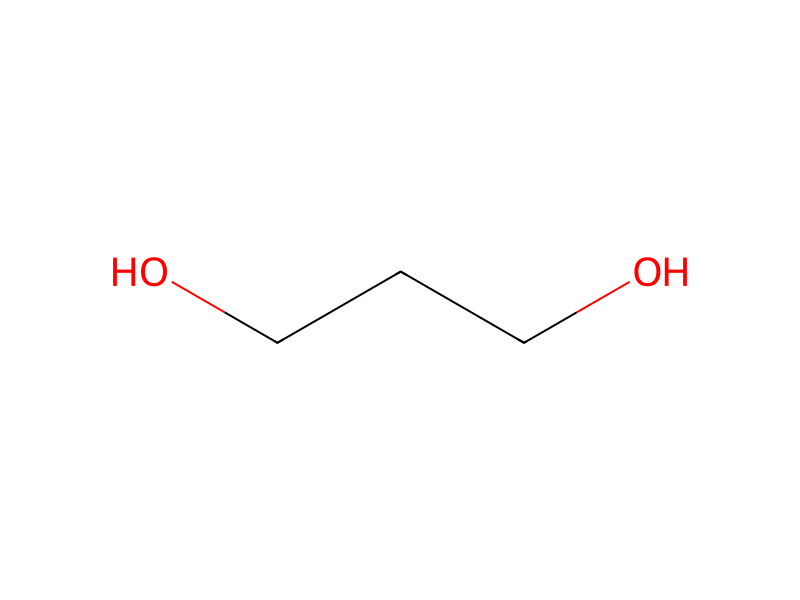
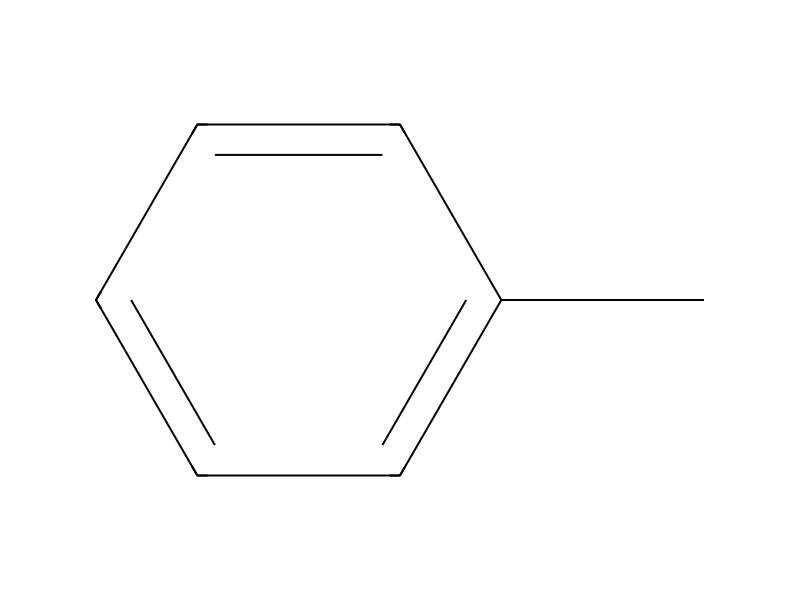
[CH2:1]([OH:5])[CH2:2][CH2:3][OH:4].[SH:6][CH:7]([C:11]1[CH:16]=[CH:15][CH:14]=[CH:13][CH:12]=1)[C:8](O)=[O:9].S(=O)(=O)(O)O>O.C1(C)C=CC=CC=1>[SH:6][CH:7]([C:11]1[CH:16]=[CH:15][CH:14]=[CH:13][CH:12]=1)[C:8]([O:4][CH2:3][CH2:2][CH2:1][O:5][C:8](=[O:9])[CH:7]([SH:6])[C:11]1[CH:16]=[CH:15][CH:14]=[CH:13][CH:12]=1)=[O:9]Participants
Reactant 3

Product 1

Reagents, catalysts & solvents 2
Procedure
1,3-Propanediol (9.50 g, 0.125 mol), a 55:45 mixture of the respective 4- and 3-isomers of mercaptophenylacetic acid (45.00 g, 0.268 mol), concentrated sulfuric acid (0.2 mL), and toluene (200 mL) were combined in a round-bottom flask equipped with a magnetic stirring bar, a water separator, and a condenser. During 6 h of heating under reflux with stirring, the solid organic acid isomers disappeared, and 4.46 mL (0.248 mol) of water was collected by the water separator. The mixture was allowed to cool to room temperature, washed in succession with 20 mL of saturated NaHCO3 solution and two 50-mL portions of brine, then dried over anhydrous MgSO4 and freed of solvent on a rotary evaporator. Dissolution of the residue in 400 mL of dichloromethane, followed by treatment at the boiling point with a small amount of decolorizing carbon, hot filtration, and rotary evaporation to remove solvent, gave 46.4 g (yield, 99%) of 1,3-propanediol bis(mercaptophenylacetate) as a viscous pale yellow oil that was shown by NMR analyses to contain the 4- and 3-isomers in a ratio of ca. 55:45, respectively: 1H NMR (in CDCl3 w/TMS, ppm): 1.91-1.96 (m, 2H, CH2CH2CH2); 3.44 (s, 4-isomer SH) and 3.47 (s, 3-isomer SH), 2H in toto; 3.53-3.63 (m, 4H, CH2C═O); 4.10-4.14 (m, 4H, CH2O); 7.03-7.44 (m, 8H, aromatic Ch); {1H}13C NMR (in CDCl3 w/TMS, ppm): 28.14 (CH2CH2CH2); 40.99 (4-isomer CH2C═O) and 41.31 (3-isomer CH2C═O); 61.64 (CH2O); 126.80-132.36 (at least 9 peaks, aromatic C); 171.20 (3-isomer C═O) and 171.41 (4-isomer C═O).
Workup
- customwere combined in a round-bottom flask
- customequipped with a magnetic stirring bar
- temperatureDuring 6 h of heating
- temperatureunder reflux
- washwashed in succession with 20 mL of saturated NaHCO3 solution and two 50-mL portions of brine
- dry with materialdried over anhydrous MgSO4
- customfreed of solvent on a rotary evaporator
- dissolutionDissolution of the residue in 400 mL of dichloromethane
- filtrationfollowed by treatment at the boiling point with a small amount of decolorizing carbon, hot filtration, and rotary evaporation
- customto remove solvent
Sources & evidence
- ORD record
- ord-9ccc254aeabb4ee88043b40b164e63fe
- Source dataset
- uspto-grants-2007_12
- Patent number
- US07312266B2
Reaction notes
Loading…