Pyridine → HCID 54355952, compound
Reaction equation

[CH2:1]([O:4][CH2:5][CH2:6][CH2:7][CH2:8][CH2:9][CH2:10][CH2:11][CH2:12][CH2:13][CH2:14][OH:15])[C:2]#[CH:3].N1C=CC=CC=1.[CH:22]1([C:25](Cl)=[O:26])[CH2:24][CH2:23]1>CCOCC>[CH2:1]([O:4][CH2:5][CH2:6][CH2:7][CH2:8][CH2:9][CH2:10][CH2:11][CH2:12][CH2:13][CH2:14][O:15][C:25]([CH:22]1[CH2:24][CH2:23]1)=[O:26])[C:2]#[CH:3]Participants
Reactant 3

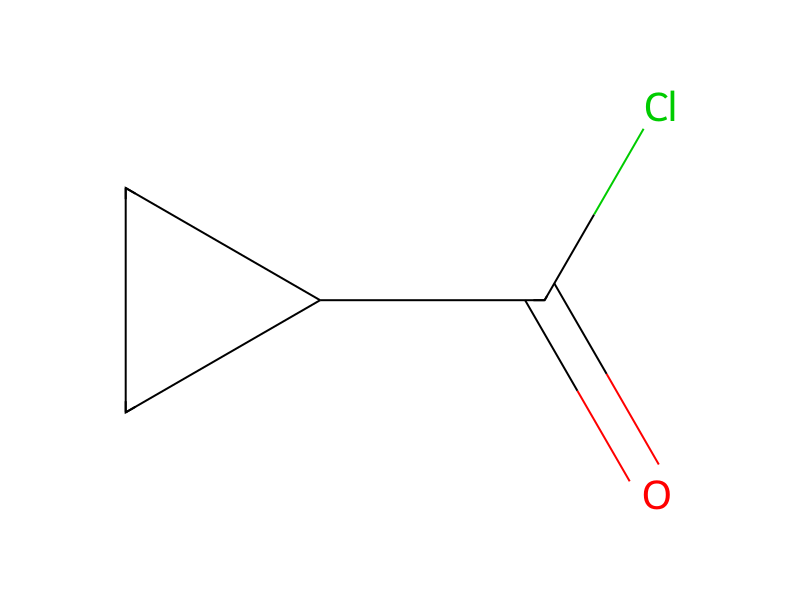

Product 1

Reagents, catalysts & solvents 1

Procedure
91 g. of 10-(2-propynyloxy)-1-decanol are dissolved in 500 ml. of ether and treated with 37 g. of pyridine. While cooling with ice and stirring, there are added dropwise 49.5 g. of cyclopropane carboxylic acid chloride and 50 ml. of ether thereto. Subsequently, the mixture is stirred at room temperature for 3 hours. The mixture is poured onto ice-water, exhaustively extracted with ether and the extract is washed with 2 N hydrochloric acid, water, 10% potassium bicarbonate solution, semi-saturated and saturated sodium chloride solution, dried over sodium sulfate and evaporated. By chromatography on silica gel with hexane/ethyl acetate (95:5 parts by volume) there is obtained pure cyclopropane carboxylic acid 10-(2-propynyloxy)decyl ester; nD25 =1.4616.
Workup
- temperatureWhile cooling with ice
- additionthere are added dropwise 49.5 g
- stirringSubsequently, the mixture is stirred at room temperature for 3 hours
- additionThe mixture is poured onto ice-water
- extractionexhaustively extracted with ether
- washthe extract is washed with 2 N hydrochloric acid, water, 10% potassium bicarbonate solution
- dry with materialsemi-saturated and saturated sodium chloride solution, dried over sodium sulfate
- customevaporated
Sources & evidence
- ORD record
- ord-ece54bfbb5d143668c6f6b20a8b955cf
- Source dataset
- uspto-grants-1979_07
- Patent number
- US04162328
Reaction notes
Loading…