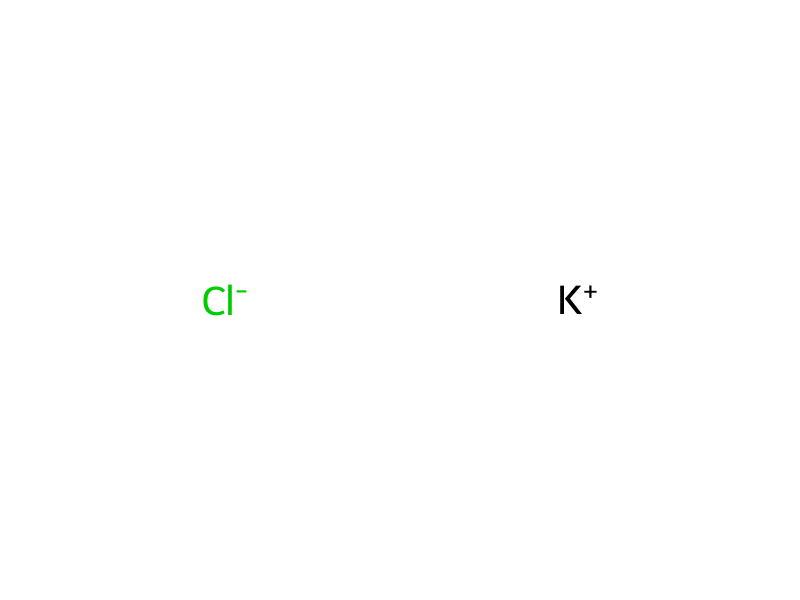
Potassium Chloride → HCID 20396306, compound
Reaction equation

[C-:1]#[N:2].[K+].[Cl:4][C:5]([Cl:18])([Cl:17])[C:6]1[CH:11]=[C:10]([N+:12]([O-:14])=[O:13])[CH:9]=[CH:8][C:7]=1[S:15]Cl.[Cl-].[K+]>C(O)(=O)C.C(OCC)C>[Cl:4][C:5]([Cl:18])([Cl:17])[C:6]1[CH:11]=[C:10]([N+:12]([O-:14])=[O:13])[CH:9]=[CH:8][C:7]=1[S:15][C:1]#[N:2]Participants
6




Conditions
- Temperature
- 10 °C
Procedure
At 10° to 15° C., 13 g of potassium cyanide is dissolved in 100 ml of glacial acetic acid. At 10° C., a solution of 61.4 g of 2-trichloromethyl-4-nitrobenzenesulfenic acid chloride in 200 ml of diethyl ether is added to the solution. The mixture is stirred for 2 hours at 10° C. and for 5 hours at room temperature. The precipitated potassium chloride is filtred off, the solvent is distilled off, and the residue is recyrstallized from petroleum ether. There is obtained 53 g (89% of theory) of 2-trichloromethyl-4-nitrophenyl thiocyanate; m.p.: 72° C.
Workup
- distillationthe solvent is distilled off
Sources & evidence
- ORD record
- ord-99bd0331371847fb89ad5e06e9a43bed
- Source dataset
- uspto-grants-1979_07
- Patent number
- US04163020
Reaction notes
Loading…