Sodium Hydroxide → Calcium lauryl phosphate
Reaction equation

[P:1]([O-:17])([O-:16])([O:3][CH2:4][CH2:5][CH2:6][CH2:7][CH2:8][CH2:9][CH2:10][CH2:11][CH2:12][CH2:13][CH2:14][CH3:15])=[O:2].[OH-].[Na+].[Cl-].[Ca+2:21].[Cl-]>O>[P:1]([O-:16])([O-:17])([O:3][CH2:4][CH2:5][CH2:6][CH2:7][CH2:8][CH2:9][CH2:10][CH2:11][CH2:12][CH2:13][CH2:14][CH3:15])=[O:2].[Ca+2:21]Participants
Reactant 3


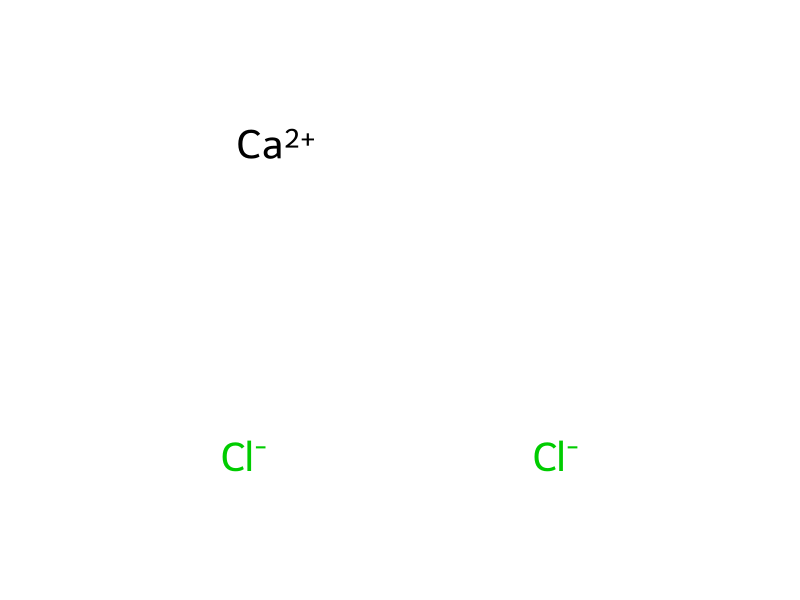
Product 1

Reagents, catalysts & solvents 1

Conditions
- Temperature
- 60 °C
Procedure
Water (19 L) was added to lauryl phosphate (molar ratio of diester/monoester=1/1; acid value, 240.2 mg KOH/g) (1 kg) while heating at 60° C., whereby the lauryl phosphate was dispersed uniformly. An aqueous solution of sodium hydroxide (300 g/L) (571 ml) was dropwise added to the mixture while keeping the said temperature. When the addition was finished, the mixture showed a pH of about 11. Further, stirring was continued at 60° C. for 60 minutes. An aqueous solution of calcium chloride (300 g/L) (802 ml) was gradually added thereto at a temperature of 50 to 60° C. After the addition was finished, the mixture was stirred at about 55° C. for 60 minutes. On confirming that the remaining calcium ion became constant, the reaction was finished. The product was collected, washed with water, filtered, dried at 70° C. for 76 hours and pulverized in a mortar to give calcium lauryl phosphate (1031 g). Yield, 95.2%. Decomposition point, >230° C. Apparent specific volume, 4.0 ml/g. Elementary analysis: calcd., P=8.2%, Ca=8.0%; found, P=8.3%, Ca=7.8%.
Workup
- additionWhen the addition
- customat a temperature of 50 to 60° C
- additionAfter the addition
- stirringthe mixture was stirred at about 55° C. for 60 minutes
- customThe product was collected
- washwashed with water
- filtrationfiltered
- customdried at 70° C. for 76 hours
Sources & evidence
- ORD record
- ord-33c69e1bce00453ea47fbb39929ee631
- Source dataset
- uspto-grants-1979_07
- Patent number
- US04163018
Reaction notes
Loading…