Chloroacetyl chloride → HCID 12369645, compound
Reaction equation
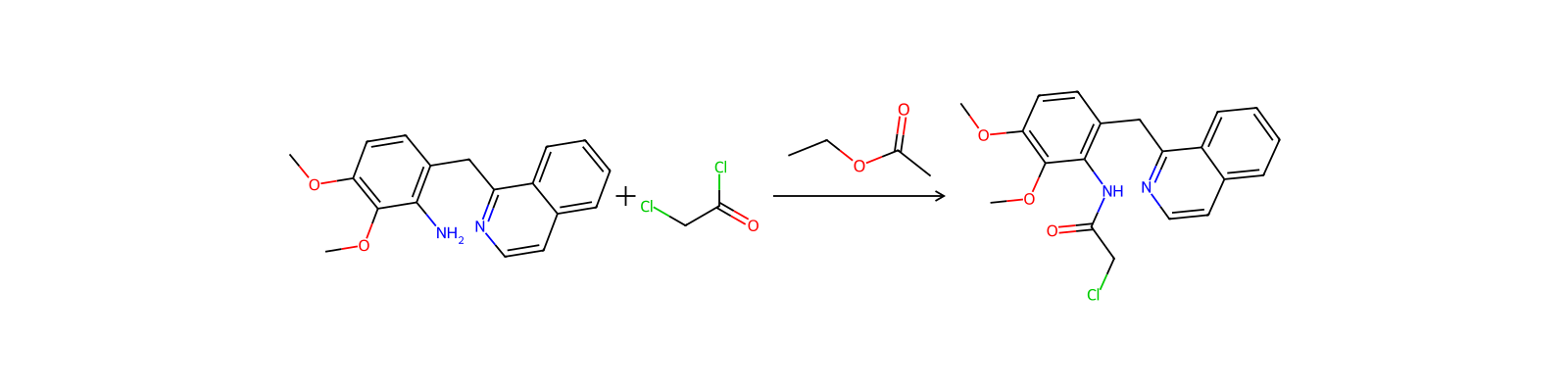
[NH2:1][C:2]1[C:18]([O:19][CH3:20])=[C:17]([O:21][CH3:22])[CH:16]=[CH:15][C:3]=1[CH2:4][C:5]1[C:14]2[C:9](=[CH:10][CH:11]=[CH:12][CH:13]=2)[CH:8]=[CH:7][N:6]=1.[Cl:23][CH2:24][C:25](Cl)=[O:26]>C(OCC)(=O)C>[Cl:23][CH2:24][C:25]([NH:1][C:2]1[C:18]([O:19][CH3:20])=[C:17]([O:21][CH3:22])[CH:16]=[CH:15][C:3]=1[CH2:4][C:5]1[C:14]2[C:9](=[CH:10][CH:11]=[CH:12][CH:13]=2)[CH:8]=[CH:7][N:6]=1)=[O:26]Participants
Reactant 2


Product 1

Reagents, catalysts & solvents 1

Procedure
1-(2-[2-chloro-acetyl]amino-3,4-dimethoxybenzyl)isoquinoline was prepared from 5.9g (0.02 mol) of 1-(2-amino-3,4-dimethoxybenzyl) isoquinoline dissolved in 400 ml. of ethyl acetate, and stirred for 2 hours with 15 ml. of chloro-acetyl chloride. The precipitate which formed was filtered and dried to yield 7.1g (87%) of the hydrochloride salt, mp 193°-194°, which was suspended in 200 ml. of water and stirred for 10 min. with 10% Na2CO3 solution. The free base was extracted with chloroform, and the organic layer was washed with water, dried (sodium sulfate) and concentrated to yield a residue which was crystallized from methanol to give the pure base; mp 166°-167°; maxKBR 1650 cm-1 (aminde C=0); δtmsCDCl3 3.75 (s, 3, OCH3), 3.90 (s, 3, OCH3), 4.20 (s, 2, CH2Cl), 4.55 (s, 2, CH2), 6.63-7.00 (m, 2, aromatic), 7.23-7.85 (m, 4, aromatic), 8.20-8.45 (m, 2 aromatic) and 9.80 (broad s, 1, NH).
Workup
- dissolutiondissolved in 400 ml
- customThe precipitate which formed
- filtrationwas filtered
- customdried
Sources & evidence
- ORD record
- ord-0bcd9882e0cb43b595a1b37c0d99c3f0
- Source dataset
- uspto-grants-1977_10
- Patent number
- US04053603
Reaction notes
Loading…