Tributyltin Chloride → Tributyl[(phenylsulfanyl)methyl]stannane
Reaction equation

[C:1]1([S:7][CH2:8][Li])[CH:6]=[CH:5][CH:4]=[CH:3][CH:2]=1.[CH2:10]([Sn:14](Cl)([CH2:19][CH2:20][CH2:21][CH3:22])[CH2:15][CH2:16][CH2:17][CH3:18])[CH2:11][CH2:12][CH3:13].[Cl-].[NH4+]>CCCCCC.C1COCC1.C1COCC1>[C:1]1([S:7][CH2:8][Sn:14]([CH2:15][CH2:16][CH2:17][CH3:18])([CH2:19][CH2:20][CH2:21][CH3:22])[CH2:10][CH2:11][CH2:12][CH3:13])[CH:6]=[CH:5][CH:4]=[CH:3][CH:2]=1Participants





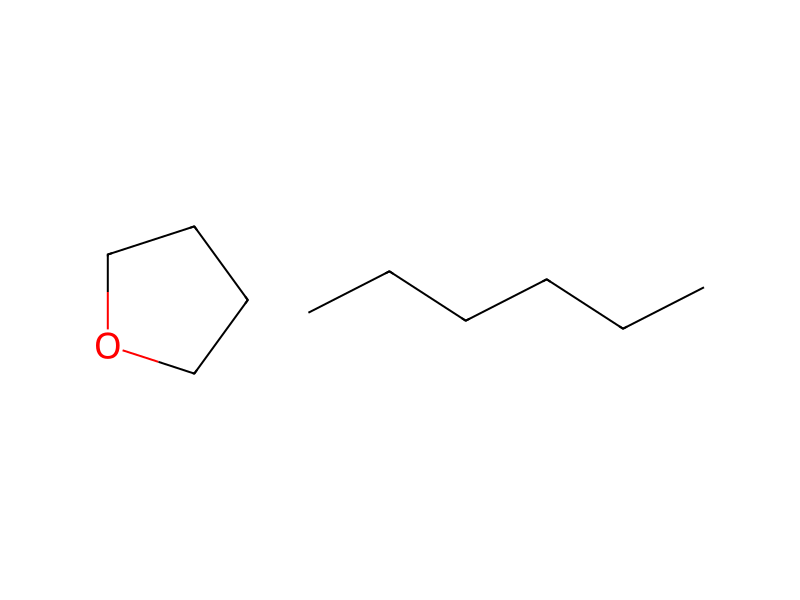
Conditions
- Temperature
- 0 °C
Procedure
Using the apparatus and procedure of Example I, 100 ml. of an approximately one-molar solution of (phenylthio) methyllithium in hexane-THF solvent was added dropwise with stirring to 0.1 mole of tributyltin chloride dissolved in THF. The temperature was maintained by means of an ice bath in the range of from 0° C to 20 C. Following the complete addition over a one-half hour period, the reaction mixture was stirred for 1.5 hours at room temperature and hydrolyzed by pouring into aqueous one-molar ammonium chloride. Extraction from the hydrolyzate with ether solvent and purification by vacuum distillation yielded the desired product, (phenylthiomethyl) tributyltin, b.p. 152°-157° C (0.09 mm). Infrared and proton nuclear magnetic resonance spectral analyses confirmed the assigned structure.
Workup
- additionthe complete addition over a one-half hour period
- extractionExtraction from the hydrolyzate
- customwith ether solvent and purification
- distillationby vacuum distillation
Sources & evidence
- ORD record
- ord-b0a0ce4241424e1ba5a4265a123abb3a
- Source dataset
- uspto-grants-1977_10
- Patent number
- US04055413
Reaction notes
Loading…