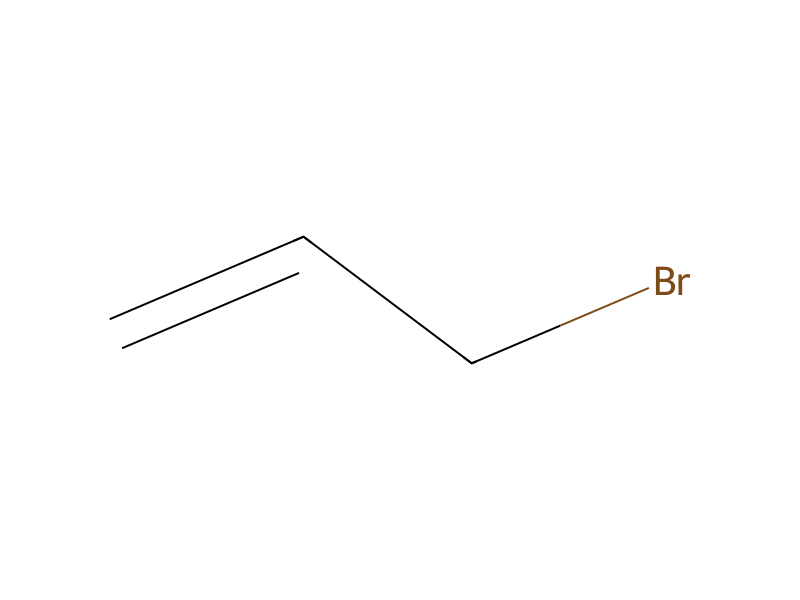
Allyl bromide → 2,2-diphenylpent-4-enoic acid
Reaction equation

[C:1]1([CH:7]([C:11]2[CH:16]=[CH:15][CH:14]=[CH:13][CH:12]=2)[C:8]([OH:10])=[O:9])[CH:6]=[CH:5][CH:4]=[CH:3][CH:2]=1.[CH2:17](Br)[CH:18]=[CH2:19]>>[C:1]1([C:7]([C:11]2[CH:16]=[CH:15][CH:14]=[CH:13][CH:12]=2)([CH2:19][CH:18]=[CH2:17])[C:8]([OH:10])=[O:9])[CH:2]=[CH:3][CH:4]=[CH:5][CH:6]=1Participants


Procedure
The compounds of the invention can be prepared by alkylation of diphenylacetic acid. For example, diphenylacetic acid was dilithiated and treated with allyl bromide to yield 2,2-diphenyl-4-pentenoic acid. This acid was cyclized to the furanone by treatment of the 2,2-diphenyl-4-pentenoic acid in formic acid with hydrogen peroxide followed by treatment with sodium hydroxide in aqueous methanol. Acidification provided the furanone which was allowed to react with trifluoromethane sulfonic anhydride in dichloromethane to afford the 5-[1-(trifluoromethanesulfonyl)methyl]-3,3-diphenyl-2- furanone. This triflate derivative was employed for alkylation of the appropriate pyrazole to produce a dihydro-3,3-diphenyl-5-(1H-pyrazol-1-ylmethyl)-2(3H)-furanone derivative or dihydro-5-[(substituted-1H-pyrazol-1-yl)methyl]-3,3-diphenyl-2(3H)-furanone derivatives.
Sources & evidence
- ORD record
- ord-ac7cfaf26e774566af7dbc765c34c461
- Source dataset
- uspto-grants-1991_11
- Patent number
- US05064850
Reaction notes
Loading…