Carbon Dioxide → Sodium Carbonate Decahydrate
Reaction equation

[OH2:1].[C:2](=[O:5])([O-:4])[O-:3].[Na+:6].[Na+].C(=O)(O)[O-:9].C(=O)([O-])[O-:13].C(=O)=[O:17]>>[OH2:3].[OH2:9].[OH2:13].[OH2:17].[OH2:1].[OH2:3].[OH2:3].[OH2:3].[OH2:3].[OH2:3].[C:2](=[O:3])([O-:5])[O-:4].[Na+:6].[Na+:6]Participants



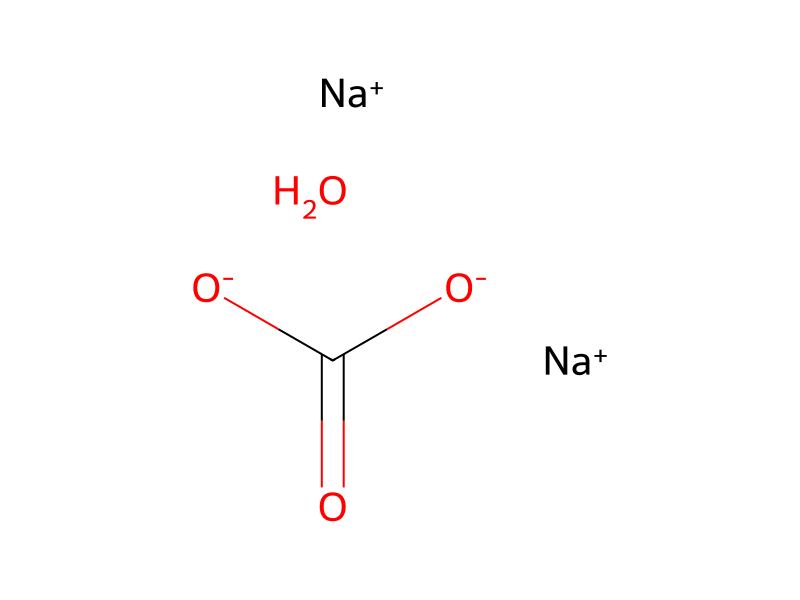
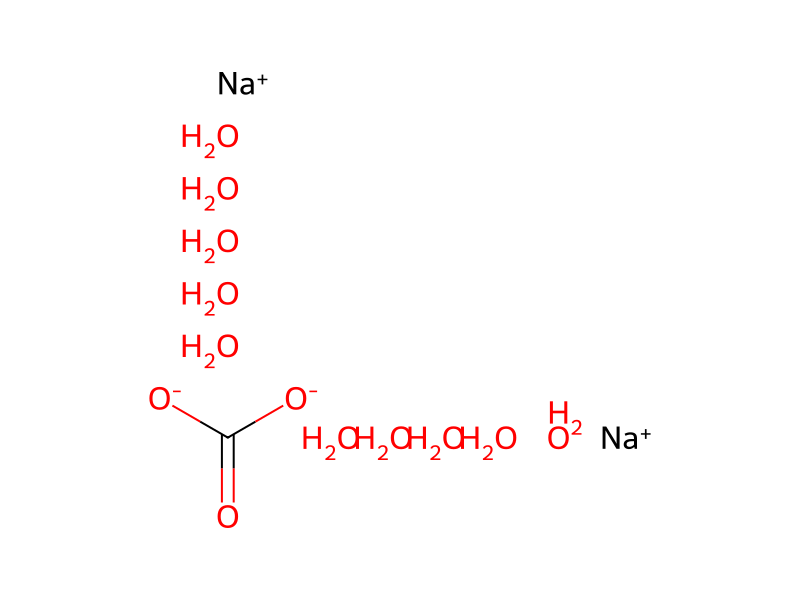
Procedure
FIG. 7 represents another useful process which incorporates the present invention. This process uses the large amount of steam available in a sodium carbonate monohydrate crystallizer train to reduce L/G ratios and accomplish significantly larger conversion of bicarbonate to carbonate. Mine water 81 is split into four streams and fed to four strippers 83, 85, 87, and 89. Preferably, each of the four mine water streams is preheated to about the operating temperature of the stripper to which it is to be fed in order to avoid significant condensation of water in the stripper. These temperatures range from about 50° C. to about 130° C. Steam 92 from the third effect evaporative crystallizer 109 is fed to stripper 83. Steam and carbon dioxide 82 exit stripper 83 and are fed to the fourth effect evaporator 99. Steam 94 from the second effect evaporative crystallizer 110 is fed to stripper 85 where steam and carbon dioxide are removed via stream 84 and fed to the third effect evaporative crystallizer 109. Similarly, steam 96 from the first effect evaporative crystallizer 111 is fed to stripper 87 and steam and carbon dioxide 86 leaves stripper 87 and are fed to the second effect evaporative crystallizer 110. Steam 90 destined for the first effect evaporative crystallizer 111 is first fed to stripper 89. The steam and carbon dioxide 88 leaving stripper 89 are then used to heat the first effect evaporative crystallizer 111. The stripped liquor 91, 93, 95 and 97 leaving the strippers 83, 85, 87 and 89 containing carbonate and remaining bicarbonate is fed to the fourth effect evaporator 99 where the liquor is concentrated. Sodium hydroxide 100 may be added, if necessary, to decompose enough bicarbonate to avoid downstream processing problems. Preferably, the system is designed to avoid the use of sodium hydroxide 100. Generally stream 101 will require bicarbonate levels less than about 1 to 2 percent to avoid sodium sesquicarbonate precipitation in the sodium carbonate decahydrate crystallization step. Steam 98 from the fourth effect evaporator goes to a barometric condenser (not shown). The concentrated solution 101 is fed to the decahydrate crystallizer 102 where the sodium carbonate solution is cooled to between about -3° C. and about 25° C. to form sodium carbonate decahydrate crystals. The resulting decahydrate crystal slurry is sent via stream 103 to the centrifuge 104 where the carbonate solution (liquor) is returned to the mine via stream 105. A purge stream (not shown) will be required at this point. The decahydrate crystals are fed via stream 106 to the melt tank 107 where they are heated to above 35° C. to form a solution of sodium carbonate which is fed via stream 108 to the third effect evaporative crystallizer 109 and the second effect evaporative crystallizer 110. Sodium carbonate monohydrate crystals are formed by heating and evaporation in these crystallizers 109, 110, and 111 from about 60° C. to about 110° C. and the resulting sodium carbonate monohydrate slurry leaves the crystallizers via streams 112, 113, and 115 and are fed to the centrifuge 116. Centrate containing dissolved sodium carbonate is fed via stream 114 to the first effect 111 and the second effect evaporative crystallizer 110. Sodium carbonate monohydrate crystals leave the centrifuge via stream 117 and are fed to the dryer 118 where water is removed via stream 119 to form soda ash 120.
Workup
- customMine water 81 is split into four streams
- customcondensation of water in the stripper
- customrange from about 50° C. to about 130° C
- customSteam and carbon dioxide 82 exit stripper 83 and are fed to the fourth effect evaporator 99
- customare removed via stream 84
- customleaves stripper 87
- temperatureto heat the first effect evaporative crystallizer 111
- customis fed to the fourth effect evaporator 99 where the liquor
- concentrationis concentrated
- additionSodium hydroxide 100 may be added
- customsodium sesquicarbonate precipitation
- customin the sodium carbonate decahydrate crystallization step
- customSteam 98 from the fourth effect evaporator
- customgoes to a barometric condenser
- temperatureis cooled to between about -3° C. and about 25° C.
Sources & evidence
- ORD record
- ord-b27a2f83661f47cc8c49f316b7279052
- Source dataset
- uspto-grants-1997_03
- Patent number
- US05609838
Reaction notes
Loading…