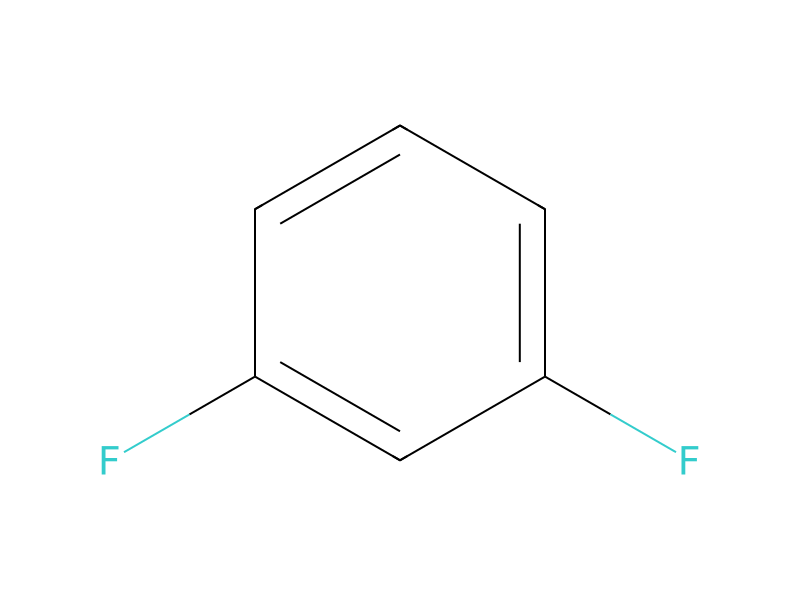
1,3-Difluorobenzene → 6-(2,6-Difluorophenyl)-quinoline
Reaction equation

C([Li])CCC.[F:6][C:7]1[CH:12]=[CH:11][CH:10]=[C:9]([F:13])[CH:8]=1.Br[C:15]1[CH:16]=[C:17]2[C:22](=[CH:23][CH:24]=1)[N:21]=[CH:20][CH:19]=[CH:18]2>O1CCCC1.[Cl-].[Zn+2].[Cl-]>[F:6][C:7]1[CH:12]=[CH:11][CH:10]=[C:9]([F:13])[C:8]=1[C:15]1[CH:16]=[C:17]2[C:22](=[CH:23][CH:24]=1)[N:21]=[CH:20][CH:19]=[CH:18]2Participants
Reactant 3


Product 1

Reagents, catalysts & solvents 2


Procedure
A 1.55 M solution of n-butyllithium (40 ml) in hexanes was added dropwise to a stirred solution of 1,3-difluorobenzene (5.7 g) in 150 ml of dry tetrahydrofuran at -78° C. After one hour at -78° C. a solution of anhydrous zinc chloride (10.22 g) in 40 ml of tetrahydrofuran was added. After a further 10 minutes at -78° C., 9.36 g (45 mmoles) 6-bromoquinoline was added neat followed by tetrakistriphenylphosphine palladium (2.5 g, 2.16 mmoles). The solution was then allowed to warm slowly to room temperature and heated to 40° C. for 12 hours. The mixture was cooled to room temperature and quenched with saturated aqueous ammonium chloride. The pH was adjusted to 9 and the product was extracted with ethyl acetate, dried over MgSO4 ; filtered and concentrated in vacuo to give a white solid (9.5 g, 88%) of m.p. 112°-113° C.
Workup
- temperatureheated to 40° C. for 12 hours
- temperatureThe mixture was cooled to room temperature
- customquenched with saturated aqueous ammonium chloride
- extractionthe product was extracted with ethyl acetate
- dry with materialdried over MgSO4
- filtrationfiltered
- concentrationconcentrated in vacuo
Sources & evidence
- ORD record
- ord-4cc3d4060a0844a5ac0ac0aa5ed55d54
- Source dataset
- uspto-grants-1987_01
- Patent number
- US04636506
Reaction notes
Loading…