P-Cresol → Phenol, 2-cyclohexyl-4-methyl-
Reaction equation

[CH:1]1[C:6]([OH:7])=[CH:5][CH:4]=[C:3]([CH3:8])[CH:2]=1.[CH:9]1(O)[CH2:14][CH2:13][CH2:12][CH2:11][CH2:10]1>O>[CH3:8][C:3]1[CH:4]=[CH:5][C:6]([OH:7])=[C:1]([CH:9]2[CH2:14][CH2:13][CH2:12][CH2:11][CH2:10]2)[CH:2]=1Participants
Reactant 2

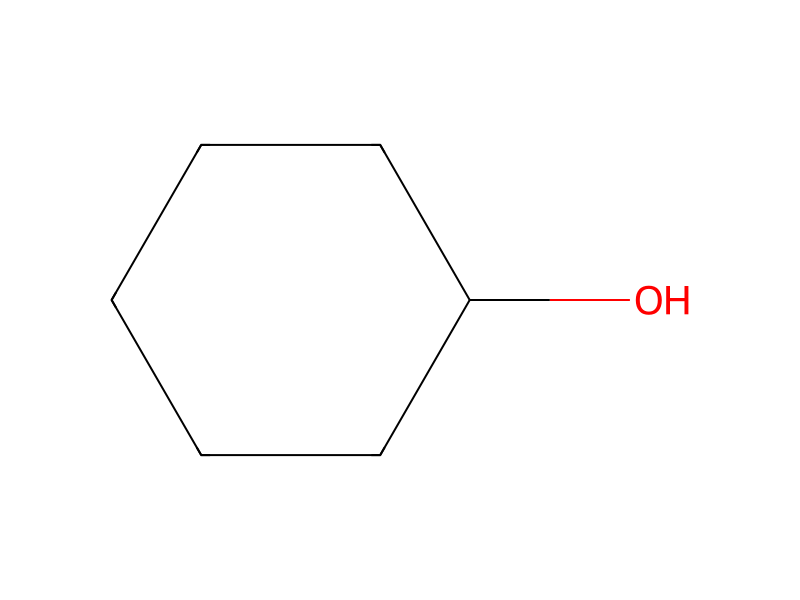
Product 1

Reagents, catalysts & solvents 1

Procedure
To carry out the process, a mixture of zeolite and p-cresol is for example heated to the desired reaction temperature with stirring. Cyclohexanol is then added in accordance with the amount of evolved water. In the case of a reaction batch of 2-4 moles of p-cresol, this generally requires a period of 3-6 hours. After all the cyclohexanol has been added, the reaction mixture is stirred at the reaction temperature for a further 2-4 hours. The 4-methyl-2-cyclohexylphenol can then be isolated from the reaction mixture by separating methods known to the person skilled in the art. For instance, it is possible first to remove the zeolite by filtration or centrifuging. However, it is also possible to leave the zeolite at elevated temperature after the reaction has ended and to decant or siphon off the reaction mixture. Such a procedure leaves the repeatedly reusable catalyst in the reaction vessel, in which, after renewed addition of p-cresol and subsequent addition of cyclohexanol, further reaction products can be obtained. The reaction mixture from which the zeolite has been removed can advantageously be worked up further by distillation. The resulting excess p-cresol is recycled.
Workup
- temperatureheated to the desired
- customreaction temperature
- stirringthe reaction mixture is stirred at the reaction temperature for a further 2-4 hours
Sources & evidence
- ORD record
- ord-c4583f934a724f93bf4dc680cf98ee1e
- Source dataset
- uspto-grants-1991_02
- Patent number
- US04990687
Reaction notes
Loading…